Tuesday, May 28, 2013

Staying Sticky, a Frog's Journey


Climbing is good. It allows for gaining access to habitats that would otherwise be unavailable. And while this access is important (otherwise, why climb in the first place?), equally important is not falling to a gruesome death. This means that your method of adhesion to the surface you are climbing needs to be effective. For example, on rough surfaces, friction pads and claws work rather well. Smooth surfaces and overhangs offer a bit more of a challenge. If you want to climb one of these surfaces you have a couple of adhesion options – dry and wet. If you are a creature that chooses dry adhesion, like a gecko, then you have toe pads covered by large numbers of finely branching setae, each ending in a flattened spatula. When these spatula come into close contact with a surface van der Waals forces allow for the sticking. You remember van der Waals forces from physics class right? Those are the attractive forces that hold together molecules in solids. If you are a creature that chooses wet adhesion, like tree frogs, then you secrete mucus from glands ending on the surface of your toe pads. This mucus makes an adhesive bond by a combination of capillary and viscous forces.

Frog toes. They’re squishy, they’re sticky, they’re cute (feel free to say that in a sing-songy voice if you haven’t already). If you look very closely, you will also see that they have a hexagonally patterned surface. In between the pad epithelial cells there are mucus-filled channels that spread the mucus over the surface of the pad, creating a thin layer that allows for wet adhesion to a surface.

Enter a new problem: How do you keep your toe pads clean? Think about any sticky surface you know. Now think about putting that sticky surface on anther surface. What happens? It gets really dirty really quickly, causing it to be less sticky. So now you are a frog that needs sticky feet to climb, and to do that you need to keep your toe pads clean so that they remain sticky. You can’t really groom your toe pads when you are using them and molting/shedding isn’t frequent enough to shed the dirt (or “contamination”). The answer: a passive self-cleaning mechanism.

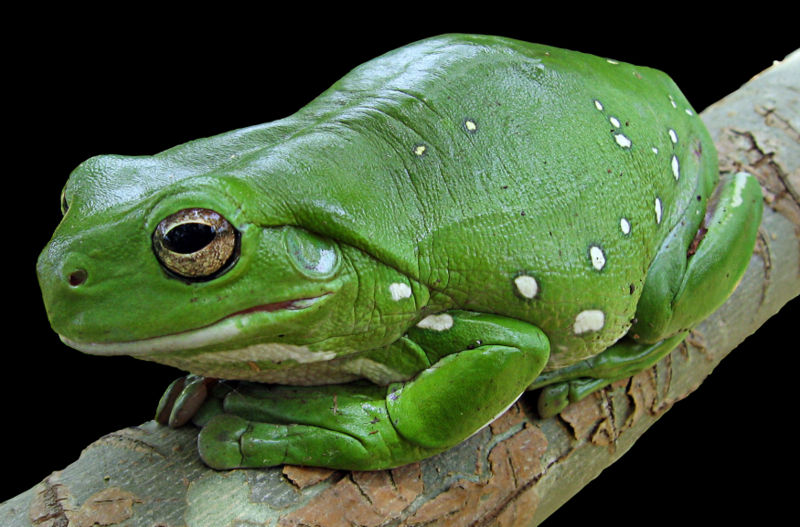
A study published in The Journal of Experimental Biology looks at this passive self-cleaning mechanism in frogs, using both single-toe experiments and whole-animal experiments. Their study animal was the Australian green tree frog (Litoria caerulea), also known as White’s tree frogs (and that dough-boy kind of cute if I must say *grin*). They used five frogs in each of their experiments, first washing them and carefully blotting them dry. (An aside, how do you get the job of tree frog washer?) For the purposes of a lab experiment, they had to create a contaminant. For this they used very small glass beads arranged in a single layer on a glass coverslip for the single toe experiment and as a thin layer in a Petri dish for the whole-animal experiment. For the single-toe experiments, the researchers used a custom-built force transducer consisting of the glass coverslip (the surface attachment) connected to a bending beam and then measured the forces in two dimensions – lateral drag and dab (simply pressed against the surface) – with and without beads. For the whole-frog experiments the animals were put on maneuverable platforms to see at what angles they began to slip and/or fall with and without beads. These experiments allowed them to calculate shear (friction) force and the normal (adhesive) force. Ever wonder when you are going to use trigonometry again? Well, if you know the body weight of the frog and the angle of the slip/fall you can calculate these forces. You're high school math teacher would be proud.

There were computer programs and statistics and equations (lots of equations) that I won’t go in to (as usual, you’re welcome). What they found is rather interesting. The whole-animal experiments showed that the toe pads of frogs will self-clean over time. With the first step, when the toe pad becomes contaminated, the adhesive and friction forces decrease, but then they recover such that by the fourth step 91.9 percent of the original adhesive forces and 98.5 percent of the original friction forces are back. These experiments also found that the more the toe pad is used the greater the recovery of the contaminated toes for both adhesion and friction forces. That is, a moving frog has cleaner toes than a stationary frog. The single-toe experiments shed more light onto why this is so. In the experiments that included the lateral drag movement, the frog toe recovered its adhesive force after about eight trials. Whereas in the dab experiments, there was little if any recovery (except if the pads were only partially contaminated). It seems that this shearing movement is an important feature of the self-cleaning mechanism, and it is one that is common in walking frogs. Frogs use this type of movement a lot on vertical surfaces and will continually re-position slipping pads to incorporate self-cleaning while maintaining adhesion to the surface. When the researchers looked even closer, at the level of pad contact area and the number of glass beads deposited on the glass during each trial, they found a correlation between adhesive force and contact area such that normal stress (adhesive force per unit area) remained constant. Since the number of beads deposited on the glass plate is a measure of self-cleaning, they were able to show a positive correlation between force recovery and contact area, particularly in the drag scenario. Essentially, as the toe pad drags along the beads get left behind, or "flushed," in the mucus footprint. Hmmm…mucus flushing doesn't make frog toes sound quite as cute.

ResearchBlogging.orgCrawford, N., Endlein, T., & Barnes, W. (2012). Self-cleaning in tree frog toe pads; a mechanism for recovering from contamination without the need for grooming Journal of Experimental Biology, 215 (22), 3965-3972 DOI: 10.1242/jeb.073809

...and if you have access there are some interesting if hard to see videos in the Supplemental Materials


(image via Wikimedia Commons)

Tuesday, May 7, 2013

The Science of Protesting

*whew* What a week it has been! As you may have noticed, I didn't post my usual Friday paper. After both my labs (yep, now I work in two) flooded and then my hard drive broke, I decided that when I got home in the evening I would just sleep. No work, no thoughts, just sleep. Now, my labs are drying out (with lots and lots of fans and a big giant mess) and things are approaching normal again.

Needing a laugh, I put together some of the funny protest sign pictures I've been collecting, all of which have a science element to them (of course). If you have any more great signs then post them in the comments, I would love to see them!

Fear science


We want time travel!

Support the metric system


Corporate snake

Evidence-based change

PhD does not equal job

Pi irrationality


Protest oil
Protesting snowmen say stop global warming and bring back Arrested Development
One down, one to go
Use your gray matter

Ecology precedes economy

Fear chickens and bedbugs

meep meep

Narwhals

Weather vs. climate

I <3 a="" method="" scientific="" the="">


Tuesday, April 30, 2013

What Hurts Worse?

The science of pain presented as a very interesting question. Which hurts worse: childbirth or getting kicked in the testicles?

Admit it, you've always wondered.


Friday, April 26, 2013

The Curious Case of the Earworm (Part 2)


In Part 1 of this topic, we explored the reasons why we like certain songs. But what transforms that likable melody into an earworm? Or is likability even a contributing factor? We took the biochemical/neurological route in Part 1, so now we’re gonna go all psychology for this one with a paper published in 2011 in Psychology of Music.

Let’s get some terminology out of the way first. We all have internally-directed thought (all that stuff you think to yourself), and we also experience spontaneous cognitions, which are those “common, everyday experiences that occur against a backdrop of deliberate goals-directed mental processes.” Musical imagery is associated with this. Involuntary musical imagery (INMI) is when a piece of music comes unbidden into your mind and repeats outside of your conscious control. It is the “earworm”, “brain worm,” “sticky music,” “cognitive itch,” and/or “stuck song syndrome.” This 2011 study looked to see if there were any patterns in everyday life that lead to an INMI episode, basically what prompts an earworm. The researchers first wanted to catalog known instances of earworms. So they used a radio feature where listeners could contact the presenter/DJ to describe their earworm experiences, and they used an online survey on the radio’s website to collect earworms. This survey allowed people to answer questionnaires and even write descriptions of the songs stuck in their heads. Their results showed eight dominant themes to describe INMI triggering. These themes were then grouped into four abstract categories (listed from most common cause to least):

Music exposure – this theme is divided into recent and repeated. Recent exposure is when you hear music and then later have an INMI experience. Repeated exposure is when you hear the music on multiple occasions before an earworm occurs.

Memory triggers – this theme relates to INMI episodes that are triggered not when you hear a song but when you remember a song. This can happen through Association in which you might sight a person, situation, word, sound, or rhythm that triggers the earworm. Or it may happen through Recollection, a personal memory that acts as the trigger. It may also be the result of Anticipation, an upcoming event that is connected to a tune.

Affective states – this theme is more situational. Your mood, stress level, and emotions can all cause earworms.

Law attention states – this theme is abstract in that it relates to circumstances where the demands on your brain are low. These times are usually when you are dreaming or when your mind wanders.

This is a psychology study and so delves into involuntary retrieval theory and states of mind. I won’t go in to all of that. I’ll simply say that this study is interesting because it categorizes the cues associated with earworms. A simple but effective exercise. If you are like me, then you probably read most or all of those and thought, “Yep, that’s how it happens with me,” or something similar.

A recent study published in Applied Cognitive Psychology, looked into this question of earworms a bit more. These researchers wanted to know what gets stuck and why. This study first uses a survey designed to collect earworm experiences, focusing on the cues that cause them, the nature of re-experiencing the song, and if commonly stuck songs are liked or disliked.

This survey found that a person’s connection to the song predicted which songs became earworms (you usually know your earworm well), and it is usually the result of recent exposure (supporting the "music exposure" results of the previous study). It also showed that the song itself was unique to the individual, and that people generally liked the song stuck in their heads but less so the more often it got stuck. That makes sense; the longer that song is in there the more you just go AHH! You know how you repeat only part of the song over and over, usually the chorus? This science says you aren’t alone, this is how it happens with a lot of people. However, if you are a musician or someone who listens to music constantly or for a large part of the day, you are more likely to develop an earworm. When the researchers had people keep an earworm diary, they found similar results.

Next, the scientists ran a few lab experiments. The first experiment tried to induce an earworm by having participants evaluate songs, then engage in an unrelated task (solving a maze), and then report any earworms. They found no effects of music type but that song order affected both earworm duration and the likelihood that the earworm would return. The last song you hear is probably the one that will get stuck in your head. The next lab experiment investigated the role of cognitive load (how strained your brain is). They used the method of the first experiment with the exception that they made the tasks harder (Sudoku puzzles of various difficulty levels), making the brain work more (hard puzzle = large cognitive load). They found that the last song became an earworm more often regardless of cognitive load, but it played for a longer time in people with more challenging puzzles. Also, if a person reported the last song as an earworm playing during the puzzle then they were more likely to have the song return later (during a lower cognitive low) as compared to those people who didn’t have the song playing during their puzzle. The last experiment was an extension of the cognitive load experiment, this time using a verbal task (solving anagrams of various difficulties) instead of a puzzle. Here, the researchers found similar results to the second experiment in that song order was important, especially for more difficult tasks. However, the last song was experienced less when completing verbal tasks than nonverbal tasks.

Whew. That was a lot of info in a small amount of space. If we sum up Part 1 and 2, what did we learn? Well, when you hear something you like your brain releases dopamine, the feel good, reward stuff. Your brain stores information about the kinds of songs you like and later uses that information to decide if it likes a song if you’ve never heard before. If it decides that you like it then it gives you your reward, making you want to hear that song again. Songs you enjoy are more likely to develop into earworms, particularly if they are the last song you hear, but there are other situational and emotional experiences that can trigger and earworm too (that whole science-is-never-simple thing again).

“I’m gonna pop some tags – Only got twenty dollars in my pocket….” ....*sigh*


ResearchBlogging.orgWilliamson, V., Jilka, S., Fry, J., Finkel, S., Mullensiefen, D., & Stewart, L. (2011). How do "earworms" start? Classifying the everyday circumstances of Involuntary Musical Imagery Psychology of Music, 40 (3), 259-284 DOI: 10.1177/0305735611418553

ResearchBlogging.orgHyman, I., Burland, N., Duskin, H., Cook, M., Roy, C., McGrath, J., & Roundhill, R. (2013). Going Gaga: Investigating, Creating, and Manipulating the Song Stuck in My Head Applied Cognitive Psychology, 27 (2), 204-215 DOI: 10.1002/acp.2897


Did you know you can still participate in the earworm study? Just go over to The Earwormery

The above image and a good little article on this topic can be found at 100.3 the Q's article "You Say Earworm, I Say Musicosis"

Thursday, April 25, 2013

Music, Earth to Space

The first ever space-to-Earth musical collaboration occurred on February 13, 2013. This endeavor was commissioned by CBCMusic.ca and The Coalition for Music Education with the Canadian Space Agency to celebrate music education in schools across Canada. Col. Chris Hadfield, a Canadian astronaut who is currently living aboard the International Space Station (I.S.S.), Barenaked Ladies, and the Wexford Gleeks from Toronto’s Wexford Collegiate School for the Arts recorded a fantastic single called “I.S.S. (Is Somebody Singing)." The song was co-written by Hadfield and Ed Robertson and explores what it's like to look down on the Earth from outer space. It will also be the official song for this year's edition of Music Monday, which takes place on May 6, 2013.


Here's the sheet music and lyrics courtesy of Music Monday:


Chris Hadfield has become a social media success and is one of the geeks you should be following on Twitter:

Also check out:

Debut of "I.S.S. (Is Somebody Singing)" on CBC Music
CBC Music article: "Ed Robertson takes us behind the writing of 'I.S.S. (Is Somebody Singing)'"

Story via:

Laughing Squid: "Barenaked Ladies Record a Song with Astronaut Chris Hadfield, First Ever Space-to-Earth Musical Collaboration"
Wired: "Astronaut Chris Hadfield Records Single (From the ISS), With Earthbound Barenaked Ladies"

Monday, April 22, 2013

Happy Earth Day!

Happy Earth Day from your friendly, tree hugging, dirt worshiping science blogger!

Here's some Earth Day humor for you.


(images via EarthDayApril, someecards, and videobash)
Related Posts with Thumbnails