Showing posts with label amphibians. Show all posts

Thursday, May 1, 2014

Deadbeat Dads: Hatching Plasticity in Glassfrog Embryos


I have recently emerged from the all-enveloping cocoon that is data analysis and presentation writing. Powerpoint, Photoshop, and JMP have been in charge of my waking hours for the past couple of weeks. But now I am free! Is that daylight and springtime I see? If you’ve been following the Facebook page then you will still have received the occasional sciency goodness, but now it’s time for me to get back to blogging.

This week a new paper published in Proceedings of The Royal Society B about baby glassfrogs caught my eye. There are more than 100 species of neotropical glassfrogs (Centrolenidae) and more are being regularly discovered. Glassfrogs are so called because of the transparent skin on their venters which allow for the observation of their internal organs. Dorsally, they tend to be green with various yellow, white, blue or red markings, with some species even reflecting light in the infrared spectrum. These frogs live high in the trees that overhang mountain streams in Mexico, Central, and South America. They make high peeps or whistles, and in some species, a single individual will initiate a chorus.

Glassfrogs are also known for their parenting skills, which seems ubiquitous across the taxon. Females lay small clutches of eggs several meters above the water on rocks or vegetation. The male will then take charge of egg maintenance, sometimes caring for multiple clutches. The male will hydrate the eggs (“hydric brooding”) in order to moderate water balance and prevent dehydration, modifying this behavior in response to weather conditions. When the eggs hatch, the tadpoles fall into the water. But sometimes a new female will show up and the male glassfrog will forget all about his clutches and he’ll take off with her. So what happens to all of his abandoned eggs?

The behavior exhibited by the males offers an excellent opportunity to study parent-embryo interactions. Early life stages in most animals are often the most vulnerable and, as such, parental care of eggs has evolved independently in many species. The term “hatching plasticity” can encompass a wide variety of these survival methods employed by embryos to increase their survivorship such as hatching early to escape danger or delaying hatching to remain in safety. Embryos can alter their rate or sequence of development. The environment and/or parental care than have both direct and indirect effects on these processes.

The authors looked at the brooding behaviors of male Fleischmann’s Glassfrogs (Hyalinobatrachium fleischmanni), specifically how embryos respond when their fathers are no longer around to hydrate them. Nightly, the researchers monitored male territories and egg clutches along stream transects near San Gabriel Mixtepec in Oaxaca, Mexico. They conducted a male-removal experiment where they displaced 40 males from their clutches and then monitored embryo survival, development and hatching time compared to the clutches of 50 attending males.

The researchers found that removing fathers significantly reduced the amount of time until hatching, with no effect on embryo survival. They found that, on average, there was a 21.2% reduction in the duration of the embryonic period for the male-removal group. This early hatching appeared to be a response to the deteriorating conditions without the fathers rather than the parent directly altering hatching time. These unmaintained eggs lost thickness (a measure of hydration) but not integrity (the egg capsules did not degrade over time) or rate of development. The neglected embryos simply hatched at a less mature stage of development. However, hatchlings from the male-removal group were significantly smaller and had fewer, less developed gut coils, the latter illustrating that age had a significant effect on development. The observed hatching plasticity was found to be due to embryos actively hatching at different developmental stages; the neglected embryos hatched at a less mature stage.

This is one of the first studies to demonstrate that embryos can time hatching to cope with variation in parental care, employing adaptive strategies to cope with these variations. The embryos are responding to their deteriorating egg environment, a dehydration-induced hatching if you will. They increase their likelihood of surviving by responding to their changing environment. A nice example of within-species coevolution.


ResearchBlogging.orgDelia, J., Ramirez-Bautista, A., & Summers, K. (2014). Glassfrog embryos hatch early after parental desertion Proceedings of the Royal Society B: Biological Sciences, 281 (1785), 20133237-20133237 DOI: 10.1098/rspb.2013.3237


And a nice little write-up over at Science called "When Dads Go Missing, Frogs Start Hatching"


(image via Tropical Herping)

Tuesday, May 28, 2013

Staying Sticky, a Frog's Journey


Climbing is good. It allows for gaining access to habitats that would otherwise be unavailable. And while this access is important (otherwise, why climb in the first place?), equally important is not falling to a gruesome death. This means that your method of adhesion to the surface you are climbing needs to be effective. For example, on rough surfaces, friction pads and claws work rather well. Smooth surfaces and overhangs offer a bit more of a challenge. If you want to climb one of these surfaces you have a couple of adhesion options – dry and wet. If you are a creature that chooses dry adhesion, like a gecko, then you have toe pads covered by large numbers of finely branching setae, each ending in a flattened spatula. When these spatula come into close contact with a surface van der Waals forces allow for the sticking. You remember van der Waals forces from physics class right? Those are the attractive forces that hold together molecules in solids. If you are a creature that chooses wet adhesion, like tree frogs, then you secrete mucus from glands ending on the surface of your toe pads. This mucus makes an adhesive bond by a combination of capillary and viscous forces.

Frog toes. They’re squishy, they’re sticky, they’re cute (feel free to say that in a sing-songy voice if you haven’t already). If you look very closely, you will also see that they have a hexagonally patterned surface. In between the pad epithelial cells there are mucus-filled channels that spread the mucus over the surface of the pad, creating a thin layer that allows for wet adhesion to a surface.

Enter a new problem: How do you keep your toe pads clean? Think about any sticky surface you know. Now think about putting that sticky surface on anther surface. What happens? It gets really dirty really quickly, causing it to be less sticky. So now you are a frog that needs sticky feet to climb, and to do that you need to keep your toe pads clean so that they remain sticky. You can’t really groom your toe pads when you are using them and molting/shedding isn’t frequent enough to shed the dirt (or “contamination”). The answer: a passive self-cleaning mechanism.

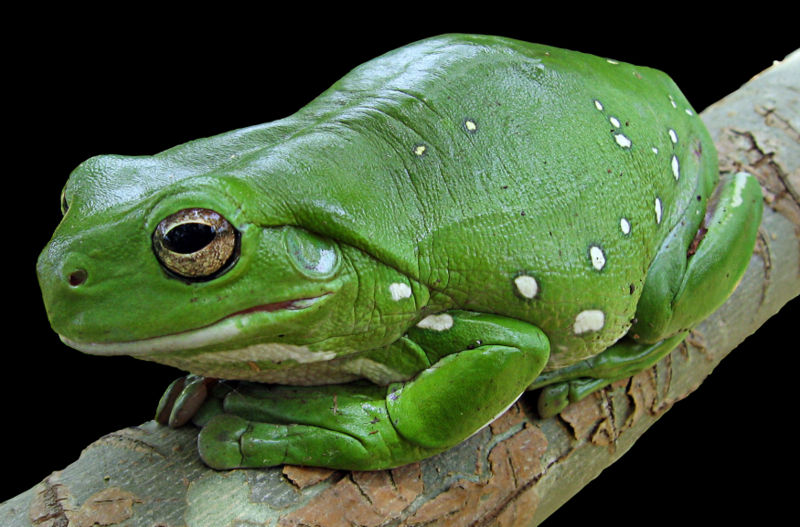
A study published in The Journal of Experimental Biology looks at this passive self-cleaning mechanism in frogs, using both single-toe experiments and whole-animal experiments. Their study animal was the Australian green tree frog (Litoria caerulea), also known as White’s tree frogs (and that dough-boy kind of cute if I must say *grin*). They used five frogs in each of their experiments, first washing them and carefully blotting them dry. (An aside, how do you get the job of tree frog washer?) For the purposes of a lab experiment, they had to create a contaminant. For this they used very small glass beads arranged in a single layer on a glass coverslip for the single toe experiment and as a thin layer in a Petri dish for the whole-animal experiment. For the single-toe experiments, the researchers used a custom-built force transducer consisting of the glass coverslip (the surface attachment) connected to a bending beam and then measured the forces in two dimensions – lateral drag and dab (simply pressed against the surface) – with and without beads. For the whole-frog experiments the animals were put on maneuverable platforms to see at what angles they began to slip and/or fall with and without beads. These experiments allowed them to calculate shear (friction) force and the normal (adhesive) force. Ever wonder when you are going to use trigonometry again? Well, if you know the body weight of the frog and the angle of the slip/fall you can calculate these forces. You're high school math teacher would be proud.

There were computer programs and statistics and equations (lots of equations) that I won’t go in to (as usual, you’re welcome). What they found is rather interesting. The whole-animal experiments showed that the toe pads of frogs will self-clean over time. With the first step, when the toe pad becomes contaminated, the adhesive and friction forces decrease, but then they recover such that by the fourth step 91.9 percent of the original adhesive forces and 98.5 percent of the original friction forces are back. These experiments also found that the more the toe pad is used the greater the recovery of the contaminated toes for both adhesion and friction forces. That is, a moving frog has cleaner toes than a stationary frog. The single-toe experiments shed more light onto why this is so. In the experiments that included the lateral drag movement, the frog toe recovered its adhesive force after about eight trials. Whereas in the dab experiments, there was little if any recovery (except if the pads were only partially contaminated). It seems that this shearing movement is an important feature of the self-cleaning mechanism, and it is one that is common in walking frogs. Frogs use this type of movement a lot on vertical surfaces and will continually re-position slipping pads to incorporate self-cleaning while maintaining adhesion to the surface. When the researchers looked even closer, at the level of pad contact area and the number of glass beads deposited on the glass during each trial, they found a correlation between adhesive force and contact area such that normal stress (adhesive force per unit area) remained constant. Since the number of beads deposited on the glass plate is a measure of self-cleaning, they were able to show a positive correlation between force recovery and contact area, particularly in the drag scenario. Essentially, as the toe pad drags along the beads get left behind, or "flushed," in the mucus footprint. Hmmm…mucus flushing doesn't make frog toes sound quite as cute.

ResearchBlogging.orgCrawford, N., Endlein, T., & Barnes, W. (2012). Self-cleaning in tree frog toe pads; a mechanism for recovering from contamination without the need for grooming Journal of Experimental Biology, 215 (22), 3965-3972 DOI: 10.1242/jeb.073809

...and if you have access there are some interesting if hard to see videos in the Supplemental Materials


(image via Wikimedia Commons)

Sunday, August 22, 2010

Saving Snot Otters


The hellbender is North America's largest salamander, and I'll argue, has one of the most badass names in all of nature. I've heard it called a "mud devil" and a "ground puppy," but it is also called a "devil dog" and, my funny favorite, a "snot otter." Individuals of this species can grow as long as 29 inches but average around 15 inches. In general, they are nocturnal, crawling along a silty, rocky riverbed to hunt small fish, tadpoles, toads, crayfish, and even other hellbenders and water snakes! During the day you can find adults defending their home rock and territory. They have lungs but don't really come out onto land much, preferring the water and taking in oxygen through their skin.

There are some populations that remain healthy, but the hellbender is listed as Near Threatened by the IUCN (that's the International Union for Conservation of Nature) and is close to qualifying for Vulnerable status. Like many other species, the decline of the hellbender is due to habitat loss and degradation - runoff contaminated with pesticides and pollutants are not good for salamanders. The Ozark Hellbender, in particular, has seen drastic population declines and is listed as Endangered in Missouri and may soon be listed as Endangered federally.

According to this short but interesting article a friend of mine posted, scientists are now cryopreserving the spiral-shaped hellbender sperm. Since this species can live up to 30 years (by the way...wow!) there are mostly older individuals left in the wild. Some of these individuals are being collected, "milked," and their little swimmers cryopreserved.

Source article:
http://io9.com/5619033/cryopreserved-sperm-could-save-giant-snot-otter-salamanders-from-extinction
http://www.nature.org/animals/amphibians/animals/hellbender.html

Saturday, March 20, 2010

Wednesday, March 3, 2010

Invasive Procedures

Cane toads were introduced to Queensland, Australia to counter pests. Well, the best laid plans and all that right? This is not a new story: non-native species is introduced to control pesky native species, non-native species decides not to eat pesky species and instead decided rare species is more delicious, non-native species multiplies and spreads to all available space it can reach, non-native species eats everything in its path, ignorant people who introduced non-native species go "oops", country spends millions of dollars to unsuccessfully control non-native species. Of course there are as many variations on this story as there are kinds of introduced species, but, well, you get the point. After all, you've seen the documentary Cane Toads: An Unnatural History (1988) haven't you? No? You're missing out; check it out. Or I suppose you can wait for the sequel: Cane Toads: The Conquest...3D!!! But I've digressed.

Here's a story sent to me by a co-worker (thanks Jeff!) which outlines some recent research which suggests that setting a can of opened cat food by a water source will attract native carnivorous ants. These ants are immune to the toxins that the toads secrete and will attack and devour baby toads on the spot. Voila! Instant toad control. Ok, so not a fix, but its a start.


This story was found at http://www.reuters.com/article/idUSTRE61I1K820100219
Related Posts with Thumbnails