Showing posts with label sociology. Show all posts

Thursday, October 8, 2015

Who Are You Wearing?: Does Competition Affect How Women View Luxury?


What do you think of when I say “luxury consumption”? Probably something that requires a Robin Leach voice over, right? Now what if I ask you why these luxuries are so valued? Is it because they are of excellent quality? Aesthetically appealing? Highly exclusive? Next, consider the audience for the luxury – who is admiring who? And what does that luxury symbolize? Status? Wealth? Success?

A recent paper in Evolutionary Psychology takes a look at these questions and has one of the best titles ever. To date, much of the research on luxury consumption has focused on why men spend so much money on brands that “offer no additional utilitarian benefits compared to their cheaper counterparts.” I found that rather odd as I tend to think of women when I think of luxury shopping. Perhaps because I am one. For example, did you know that an Hermès Birkin bag can go for over $200,000? Yes, that is an extreme example, but think about how many women you see every day that carry Coach bags, wear designer brand clothes, and/or own at least one pair of Jimmy Choo shoes. Put that way, perhaps it is unsurprising to know that women spend huge sums of money on “conspicuous luxuries,” an average of $100 billion each year. This study looked at the psychology of women in relation to symbolism of these luxuries by breaking it down into two experiments.

Experiment 1 – Does competition trigger women’s luxury consumption and preferences?

A group of 195 women, under the age of 50 and of various incomes and education levels, completed an online survey. A 2 (context) by 2 (luxuries) by 2 (product type) factorial design used to test fictional scenarios.

In the context of competition:

Competitive Scenario: Women were asked to rate four pictures of attractive women. Then they were asked to read a scenario with those pictures in mind. For example:

Imagine that you are at a class reunion and you meet an attractive, smart, funny, intelligent man with an engaging personality. However, the woman in the picture also shows an interest in this man and she has struck up a conversation with him while you were gone to get a drink.

Noncompetitive Scenario: Women were asked to rate four pictures of landscapes for attractiveness. Then they read a scenario such as:

Imagine that you are walking through the most beautiful landscape and you enjoy the environment, weather and views.

The luxuries and types:

Women were asked to read a description of a luxury product that enhances physical attractiveness (like a dress) or a neutral product that does not (like a smartphone). Then the luxuriousness of the product was manipulated by using various adjectives. For example:

“Imagine you see a little black dress in a store. It is a very expensive but beautiful dress. The dress is a unique piece of an exclusive clothing line. It has an excellent quality and is only available in a luxurious clothing store. When wearing this dress you will feel luxurious.”

When asked to read the scenario, they were asked to imagine the items in a fashion store and rate how much they liked the item.


They found that women in the competitive context felt more competitive, and women in the luxury condition found products to be more luxurious. Okay, yeah, I would pretty much expect that. But more specifically, they found interaction: women who perceived the luxury smartphone as more luxurious and expensive in the competitive context. It was context that ended up playing the dominant role in female-female competition, particularly with luxury items that enhance physical attractiveness (like the dress). I definitely believe that one.


Experiment 2 – What do luxury goods signal to rival females?

An online survey was also used for this experiment. A 9 (product) by 2 (product type) between-subjects design was used. First, women read a scenario where a woman leaves for a trip and upon arrival realizes she forgot a product. So she goes on a shopping trip and purchases Product X for Price Y. In the luxury condition a dress or watch would be purchased for 300 Euro (did I mention this was conducted in Belgium?). In the non-luxury condition, an alarm clock or night cream would be purchased for 15 Euro. Next, respondents were asked to assess the woman on various traits (attractive, sexy, loyal, smart, mature, ambitious, wealthy, etc.) and mate value (agreeableness, sexual willingness, ambition, status, etc.). They were also asked if they would consider this woman to be a friend, if she spent a lot of money on that product, and if they would spend similar amounts of money.

The respondents in the luxury condition agreed that the woman spent a lot of money on the product, and that they would spend less money on it. This luxury-loving woman was also perceived to be more attractive, sexier, flirtier, youthful, ambitious, and richer but less loyal, mature, and smart. She was also less likely to be a potential friend. However, there no differences between the mate value perceptions and the degree to which the woman was considered to be a rival. There were also some interaction terms here. For example, the woman was perceived to be more youthful in the luxury condition when she purchased the attractiveness enhancing product.

So what do we take away from all of this? Perhaps we just like the self-promotion. Or maybe we just feel more attractive wearing a luxury dress. Yeah, sure, maybe. But these results really show that we like to look luxurious to up our attractiveness to beat another woman. Frankly, ladies, we sound like judgmental bitches.


ResearchBlogging.orgHudders, L., De Backer, C., Fisher, M., & Vyncke, P. (2014). The Rival Wears Prada: Luxury Consumption as a Female Competition Strategy Evolutionary Psychology, 12 (3) DOI: 10.1177/147470491401200306

Thursday, February 12, 2015

Will You Be My Valentine?: Making All the Right Moves


My Valentine’s Day themed posts have been both popular and fun to write. In last year’s Getting a Date for Valentine’s Day series, you learned that you should wear something red, gaze without being creepy, tell a good joke before walking up to your potential date who is preferably standing next to some flowers, and then open with a unique request to segue into asking them out. But that isn't the end of the story. Oh no, there are many more things that you can do to attract that special someone, all scientifically examined of course. Today we’ll take a look at two more of them.

Bust-A-Move


It’s serendipity that our V-day themed discussion about sexual selection starts on Darwin’s birthday (Happy Birthday Chuck!). Did you know that Charles Darwin was actually the first to suggest that dance plays a role in evolution? It is a sexually selected courtship signal that reveals the genetic or phenotypic quality of the dancer, usually the male. Basically, the quality of the movement signals things like physical strength and fluctuating asymmetry (FA). The latter is a term you see a lot in these types of studies and it describes how much an organism deviates from bilateral symmetry. Essentially, if you develop all lopsided then it will show in your movement. Take what you know of testosterone, or other steroids. Increase that and you see improved physical strength and athletic ability. Now translate that, and its developmental implications, to dance.

It has been suggested that human women have developed ways to assess these visual cues in men in order to select high quality mates. However, quantifying these decisions in a study has proven difficult as women use the appearance of the dancer as well as their quality moves. A 2009 study by Hugill et al. in the journal Personality and Individual Differences looked at whether male physical strength is signaled by dancing performance. They included 40 dancers, recorded their age, body weight and height and then gave them a series of handgrip tests to quantify their physical strength. Then they dressed the men all in white overalls (I know, sexy right?), put them in a blank grey room, and asked them all to dance alone to the same song while they were being video recorded. Let’s assume, for the sake of this argument, that this scenario doesn’t induce awkwardness in these men. Then each video was converted to grey-scale and a blurring filter applied to cover information about body shape. Once this prep work was done, the researchers recruited 50 female to rate each video. The results showed that the women perceived the dances of physically stronger men as more attractive.

The rise of motion-capture technology has added a very useful tool to this type of study. Rather than going through all of those post-conversion video steps, complex movements like dance can be captured by the computer sensors to be applied to homogeneous human figures. A 2005 study by Brown et al. in Nature did just this to look at the variation in dance quality with genetic and/or phenotypic quality. They motion-captured 183 dancers and selected 40 dance animations based on the composite measures/level of fluctuating asymmetry of the dancer (hmm…I wonder if they could get Andy Serkis to help out). Then they showed these dance animations of symmetrical and asymmetrical individuals to 155 people (themselves characterized for FA) to rate. In both males and females, the results showed that symmetrical individuals were better dancers, with males better than females, but sex didn’t matter within the asymmetrical group. For the raters, generally males liked to watch female dancers rather than male (you’re shocked, I can tell), and females liked symmetrical males. Data also showed that female raters, more than male raters, preferred the dances of symmetrical men, and that symmetrical men prefer symmetrical female dancers more than do less-symmetrical men. If you have ever interacted in any social context ever then you know that beautiful, good dancers liking beautiful, good dancing partners isn’t exactly groundbreaking. But what does this study mean for the hopelessly asymmetrical? Shift your preferences downward to a less symmetrical potential date.

Now the question becomes about the dance itself. Which body movements are the attractive ones? A 2010 study by Neave et al. published in Biology Letters looked at specific movement components within dance to see which one(s) influenced perceived dance quality. Using motion-capture, the created digitally dancing avatars of 19 men for 37 women to rate for dance quality. To quantify specific movements, angles, amplitudes and durations of joint, angular and unidirectional movements were measured. Good dancers were those that had larger and more variable movements with faster bending and twisting movements in their right knee. Weirdly specific, right? Especially that right knee thing. But, considering that most people are right-handed, this might be expected.

So what have we learned? Well, we now know that how you move tells someone a lot about you, regardless of how attractive you are. Maybe a good dance class is in order?

ResearchBlogging.orgHugill, N., Fink, B., Neave, N., & Seydel, H. (2009). Men’s physical strength is associated with women’s perceptions of their dancing ability Personality and Individual Differences, 47 (5), 527-530 DOI: 10.1016/j.paid.2009.04.009

ResearchBlogging.orgBrown, W., Cronk, L., Grochow, K., Jacobson, A., Liu, C., Popović, Z., & Trivers, R. (2005). Dance reveals symmetry especially in young men Nature, 438 (7071), 1148-1150 DOI: 10.1038/nature04344

ResearchBlogging.orgNeave, N., McCarty, K., Freynik, J., Caplan, N., Honekopp, J., & Fink, B. (2010). Male dance moves that catch a woman's eye Biology Letters, 7 (2), 221-224 DOI: 10.1098/rsbl.2010.0619

Hey baby, you must be gibberelin, because I'm experiencing some stem elongation.


You've got your eye on someone fabulous. You walk over; lean against the bar and…


What you say next can make or break that first meeting. What do you say? There are several studies out there that look for practical answers to this question. Considering our current dating discussion, we’ll hone in on pickup lines (or chat-up lines), which run the gamut from cute to cringe-worthy. In general, these types of studies ask “What makes a pickup line good?”


To get at this, many categorize them according to a 1986 study by Kleinke et al.:
  1. Cute-flippant – convey interest with humor that is usually flirtatious or sexual 
    • “You must be tired, because you’ve been running through my mind all day,” (A line that has actually been used on me. Sigh.) 
    •  “Do you have any raisins? No? Well then, how about a date?” 
  2. Innocuous – convey interest without incurring the pain of from potential rejection by using simple questions to start conversations 
    • “Have you seen any good movies lately?” 
    • “What do you think of the band?” 
  3. Direct – convey interest with sincerity and flattery 
    • “I saw you across the room and knew I had to meet you. What’s your name?” 
    • “Can I buy you lunch?”
Evolutionarily speaking, women are making choices that optimize the viability of any offspring, but the male attributes they prefer are dependent on the type of relationship they are seeking. If they are looking for a long-term relationship then they prefer males who appear likely to be good fathers. Broadly, these women are picking up on signals for warmth-trustworthiness (honesty, reliability, kindness) and status-resources (intelligence, dominance, earning potential). If they are looking for a short-term relationship then signals of good genes like attractiveness and health are important. A 2010 study by Senko and Fyffe applied this evolutionary perspective to pickup lines, examining the perception of these signals. They asked 70 women to imagine that a man comes up to them and initiates contact using either a flippant, innocuous, or direct pickup line. Then the women rated that imaginary man on several attributes including trustworthiness, intelligence, sociability, sense of humor, and creativity. The women also reported their willingness to carry a conversation and long-term or short-term relationship potential. The original Kleinke study found that everyone agreed that cute-flippant lines were the worst; go with innocuous or direct lines. Both studies found this to be particularly true for women. Senko and Fyffe found long-term relationship seeking women much less receptive to a flippant pickup line even though the men were judged as more sociable, more confident, and funnier. Conversely, they were also deemed to be less trustworthy and less intelligent. Short-term relationship seeking women judged a man based on his attractiveness rather than his choice of opener. Nice when your findings line up with the theory isn’t it?

Okay, so now we have zeroed in on the categories that work best: innocuous and direct. But is there something about the lines themselves that make them successful? A 2006 study by Bale et al. aimed to construct a pencil and paper instrument to index the effectiveness of pickup lines and identify cues as to their effectiveness. To do this, they created 40 vignettes in which a man attempted to start a conversation with a woman including 20 “one-liners” chosen as signals of particular male traits. Then participants were asked to rate the man’s pickup on whether or not a woman would continue the conversation. As with the previous studies, pickup lines involving jokes, empty compliments and sexual references rated poorly. Lines that indicated those evolutionary desirable traits did best: generosity, cultured, and physical fitness.

A 2007 study by Cooper et al. built on the Bale et al. work, looking at the effect of personality on the response to pickup lines. This study proposed that these openers can have two functions: attraction and selection. These functions may allow men to increase their effectiveness by skewing the distribution of women they attract towards a particular personality type. The researchers used the short scale version of the Eysenck Personality Questionnaire Revised (EPQ-r) to measure the personality traits of the participants. They also asked the participants to complete a Dating Partner Preference test which asks them to rate 33 adjectives to show how they felt about the trait in a prospective dating partner. Generally, they found four groups of adjectives that were preferred: good mate, compliment, sex (preferred by males), and humor (preferred by females). Are you sensing a theme yet? They also combined their dataset with Bale et al. to establish the relationships among vignettes to explore the effect of the sex of the participant. Women rated humorous items more favorably and sexually loaded lines less favorably than did men. (Again, you’re shocked, I know.) However, it turned out that men underestimated some things; like when he revealed wealth or proffered help in a way that showed off his character and when he handed over control of the interaction to the woman. On the flip-side, he also overestimated how she responded to showing off his accomplishments, especially if it was laden with innuendo.

Lessons learned from this? Construct your pickup lines carefully. Sure, humor is important but in pickup line form it just makes you look like an idiot. Instead, ask her what she thinks, listen and respond intelligently, and talk about yourself without being a show-off. In short, be a normal person, not a weirdo.


ResearchBlogging.orgKleinke, C., Meeker, F., & Staneski, R. (1986). Preference for opening lines: Comparing ratings by men and women Sex Roles, 15 (11-12), 585-600 DOI: 10.1007/BF00288216

ResearchBlogging.orgBale, C., Morrison, R., & Caryl, P. (2006). Chat-up lines as male sexual displays Personality and Individual Differences, 40 (4), 655-664 DOI: 10.1016/j.paid.2005.07.016

ResearchBlogging.orgCooper, M., O’Donnell, D., Caryl, P., Morrison, R., & Bale, C. (2007). Chat-up lines as male displays: Effects of content, sex, and personality Personality and Individual Differences, 43 (5), 1075-1085 DOI: 10.1016/j.paid.2007.03.001


(images via How Stuff Works, BuzzFeed, and QuickMeme, respectively)

Friday, December 12, 2014

The White Elephant in the Room: The Gift of Subversion


Ah, the holiday work party. Free food, spending time with people you spend your whole day with already, and enough boozy libations to make things a bit more interesting. Here in North America, many workplaces engage in the gift “game” called the White Elephant Gift Exchange. On this topic, I'm basing today’s post on an article that I recently came across by Gretchen Herrmann in The Journal of Popular Culture where she dissects the Machiavellian nature of this little holiday game.

The White Elephant Gift Exchange (that I’ll abbreviate to WEGE, which you are free to pronounce as ‘wedgie’ even though no one does) is a pastime aimed to upend our normal conventions and beliefs of holiday generosity by celebrating and subverting the materialism. The goal is an unleashing of entertainment and satire, made all that much better after the first glass or two of eggnog.

I've written before on the topic of the perfect gift, concluding that considering someone’s interests and getting them something that you know they will love and use is the way to go. Herrmann generally agrees on this conclusion, pointing out that the ideal gift is a special item that is imbued with personal sentiment. This special item carries with it an emotional attachment that transcends the obligatory reciprocity of typical gift-giving. But object of the WEGE is exactly the opposite of all of that.

Actually, the name WEGE can vary depending on the type of gifts. The specific version of the game typically goes after a particular brand of holiday subversion: shrewd trading and parsimony (e.g., Yankee Swap, Scotch Auction), undercutting holiday beneficence (e.g., Dirty Santa, Evil Santa), turning Christmas on its head by those that are considered inscrutable and untrustworthy (e.g., Chinese Christmas, Chinese Gift Exchange), pointing to the dubious value of the gift or that it might be pre-owned (e.g., WEGE), and/or telegraphing personal gain at the expense of others (e.g., Stealing Santa, Rob Your Neighbor, Cut Throat Christmas).

Basically, the rules are these:

  1. Participants bring an anonymous wrapped gift that fits within prespecified guidelines (price, regifting, etc.) that they slip into the gift pile. 
  2. Everyone picks a number that is used to determine the gift-choosing order of the participants. 
  3. First Turn: The first person called chooses a gift from the pile, opens it, and then displays it to the other participants. 
  4. Second Turn: The next person has three choices. They can either a) steal the gift from the first person, sending them back to the gift pile for another, b) select, unwrap and keep a gift from the pile, or c) select and unwrap a gift from the pile and swap the unwanted gift with the first person. 
  5. All Subsequent Turns: Each new person can steal any unwrapped gift or choose a wrapped gift from the pile. However, a gift can’t be stolen more than once during a turn, and a particular gift can’t be immediately stolen back from the participant who just stole it.

WEGE it isn’t about the personalization, it’s about the stealing. The Machiavellian nature of the game is spelled out in its stealing, its taking, its greed. Rather than the generosity of the personalized, perfect gift, the emphasis is placed on personal gain, creating a series of winners and losers, and getting something for nothing with impunity at the expense of another. I think we can all agree that that is what makes it fun.

You want to make sure that you bring a gift that will engender group favor and can trigger a chain reaction of stealing and hilarity. For example, one of the most popular gifts I’ve seen at one of these events was a big battle axe. Yeah, a real one. How many times it was stolen = funny; who actually wanted a battle axe for their very own = hilarious. In other years, the same group went crazy over gifts like a big stuffed moose or a case of craft beer (I ended up with that one!). So is there a key to picking out the perfect gift for one of these events?

First is to consider your group. Do they appreciate the tacky, silly, and weird or are they more the classy, mainstream crowd? However, slipping a bizarre gift into the latter crowd’s pile will likely cause unexpected amusement. Second is to keep to those prespecified rules. Don’t spend a lot of money trying to impress people; keeping to the anonymity means they won’t know it was you anyway. Next is to not forget the creative wrapping and use it to satirize as well – although you might have to be equally creative to keep it anonymous as you walk into the party.

Herrmann explores the transient nature of both the receiving of the gift and your attachment to it. In the game, the gift itself can be arbitrary and that participants are forced to focus on the transience of possession instead. She cites behavioral economists who describe the “endowment effect,” wherein the brief possession of an item makes it worth more to the owner than other identical items. This extra value makes the stealing of this item even that much more poignant. However, she also points out what we’ve all heard during particularly rousing games: “Give me that! I want it!” so there is at least some value of the item too.

Herrmann breaks down the gifts into three categories:

Fetishized Commodities: Those items that are disproportionately coveted and stolen. My battle axe example is a good one. These gifts take on a life of their own as they gain more value every time they are stolen. A hierarchy of items can emerge as the game goes on. Within this hierarchy are also a series of substrategies like pointing out other gifts to take attention away from yours, loudly hawking lousy gifts in the hopes of trading up, sitting low and hopping no one will see and remember what you have, or even making after-game deals.

Booby Prizes: Of course, no one wants to end up with the “booby prize” or gifts at the undesirable end of the hierarchy. So much so that often the rules will stipulate that the final recipient must take it home with them. It can sometimes be difficult to predict whether a gift will be seen as a booby prize. Perhaps the battle axe was originally meant as a booby prize, a way offload an old D&D costume. But bad became good.

Lazarus Gifts: These are the items that make reappearances in coming years. They are the ones that are most commented on, laughed about, or pawned off. These resurrected gifts actually add to the layers of complexity and amusement of the WEGE.

Ultimately, the WEGE is about group bonding through entertainment. Perhaps that’s why it is so often played at workplace parties. There’s a ritualistic swapping of gifts, but you don’t need to go through the stress of finding the perfect gift. So this year, think of a creative, subversive, fun WEGE gift. Oh yeah, and don’t forget to steal all those good ones away too!


M. Herrmann, G. (2013). Machiavelli Meets Christmas: The White Elephant Gift Exchange and the Holiday Spirit The Journal of Popular Culture, 46 (6), 1310-1329 DOI: 10.1111/jpcu.12090


(image via The Lovely Journeys)

Thursday, October 23, 2014

Trick-or-Treating: What Do You Hand Out On Halloween?


Halloween is almost here. And you know what that means: Candy! It’s one of those Halloween traditions that I just never seem to have grown out of. Those little chocolate bars are seriously dangerous to my waistline. Remember how much Halloween candy you ate when you were a kid? Were you one of those kids who gorged on all that sugary goodness, or were you the type to parse it out and make it last? I was a Trader, that kid that made deals to trade all her bad candy for the good stuff. Anyway, the topic of Halloween candy got me to searching through the scholarly journals in search of an article for today’s post. I came across a paper that asks if children really need all of that candy on Halloween. My first instinct was “Of course they do! It’s Halloween!” But, well, read on…

It seems that being a fat American isn't just limited to adults, childhood obesity has been on the rise over the last 3 to 4 decades. Access to unhealthy foods and the poor nutritional quality of their diets is much to blame for this. The promotion and glorification of high sugar, high fat foods on Halloween is simply a good example. It probably comes as no surprise that research has shown that when children are given free access to tasty food that they eat it, especially if it’s sweet, even when they are not hungry. But is there a good alternative that kids will like? A slightly older paper published in Journal of Nutrition Education and Behavior investigated the option and value of nonfood treats as substitutes for candy on Halloween.

To do this, the researchers gave 284 trick-or-treating children a choice of a toy or candy. The toys included stretch pumpkin men, large glow-in-the-dark insects, Halloween theme stickers, and Halloween theme pencils. The candy choices were recognizable name brand lollipops, fruit-flavored chewy candies, fruit-flavored crunchy wafers, and “sweet and tart” hard candies. All of these toy and candy options ranged between 5 and 10 cents per item. When a trick-or-treating child arrived at a door, they were asked for their age, gender and a description of their Halloween costume (pretty typical…except maybe the gender question). Then they were presented with 2 identical plates: 1 with 4 different types of toys and the other with 4 different types of candy, alternating by site/household which on side the plates were located. Only children between 3 and 14 were included. And, if the child asked for both toy and candy, they were allowed to take both but were excluded from the study, but only 1 little girl did that.

The results of the study showed that children chose toys as often as they chose candy. This suggests that children may forego candy more readily than adults expect. The authors cite Social Cognitive Theory as providing a way for candy alternatives to become more commonplace. According to this Theory, when parents see that children are accepting the candy alternatives they are more likely to continue the new toy giving behavior. Factor in the other fun Halloween activities – dressing up, walking around the neighborhood at night, etc. – and these toy treats become positively associated with the fun and the holiday.

Okay, so what about the Halloween-only-comes-once-a-year argument. I’ll admit it is a good one and it something that the authors spend time to address. They point out that Halloween isn’t the only holiday where food and candy are advertised. Well, isn’t that the truth. They even make a nice list of other food laden holidays and events: weddings, new babies, graduation, back-to-school, birthdays, Christmas, Hanukkah, Valentine’s Day, Easter, St. Patrick’s Day, Cinco de Mayo, Earth Day (wait…you get food on Earth Day?), Mother’s Day, Father’s Day, and Independence Day. What they don’t add in are all of the other food-filled events that come seasonally (picnics, cook-outs, etc.) and socially (happy hours, get-togethers, etc.). Put together, that’s a lot of bad food choices all year long.

Ultimately, what the authors are getting at is promoting healthy choices throughout the year. Part of this is giving children healthier options and traditions. It is almost more of a change for adults than it is for children. Breaking those food habits and associations isn’t easy, y’all. Food isn’t love, no matter how many Hershey’s Kisses you give someone. Wow did that ever sound shrinky!

But I’ll throw in a last little note that I think almost every child on the planet would agree with: Don’t be that house than hands out toothbrushes.


ResearchBlogging.orgSchwartz, M., Chen, E., & Brownell, K. (2003). Trick, Treat, or Toy: Children Are Just as Likely to Choose Toys as Candy on Halloween Journal of Nutrition Education and Behavior, 35 (4), 207-209 DOI: 10.1016/S1499-4046(06)60335-7


(image and product via epicurious)

Monday, August 25, 2014

Spoiler Alert!: Are You Wasting Your Time Avoiding Spoilers?

Spoiler Alert
Lately I have been cranking though a lot of media – TV, movies, books, podcasts, etc. To the point that I start to wonder how I have time for actual life. During this mass consumption of media, I've been thinking about, and discussing with friends, the topic of spoilers. Bring up this topic with just about anyone and you’ll find that it’s actually a pretty controversial one. As for me, I fall in the no spoilers category. Spoil one of my beloved TV shows and you will go from friend to “friend” just that fast. But I know that there are those out there that don’t mind being spoiled or actually prefer it. That got me to thinking back to a study from few years ago about this topic. The study got quite a bit of attention from the media, specifically applying the findings to film and TV. After doing some searches on Web of Science for similar studies, I can see why. There just aren’t any – to the point that even this older study has only been cited 3 times, and not by other media related studies. So, well, what the heck?

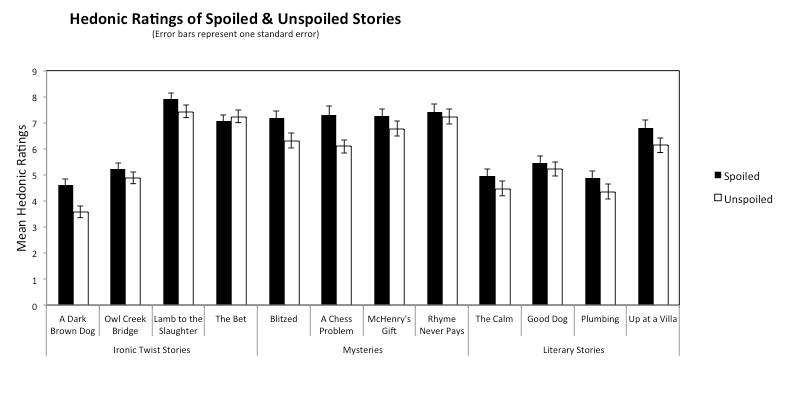
In 2011, a short little study published in Psychological Science by Leavitt and Christenfeld asked if spoiling a story decreased peoples’ pleasure in it. The universal element of all types of media is story. When you talk about spoilers you are inherently talking about changing someone’s enjoyment of the story. The study asked 176 males and 643 females (just a little sex biased and not broken down by any other demographics) to take part in three experiments in which they read three different sorts of short stories selected from anthologies: (1) Ironic-twist stories, (2) Mysteries, and (3) Evocative literary stories. For each of the stories, some of the participants’ stories included a spoiler paragraph that summarized the story and gave the outcome. Afterwards, the participants were asked to rate the story for enjoyment on a 10 point scale – a “hedonic rating.” They found that the participants significantly preferred spoiled over unspoiled stories in all categories and reported that the spoiler paragraph was not out of place or jarring.

Figure 1 from the study. These are hedonic ratings of the individual spoiled and unspoiled stories.

Considering all of the attention this study got when it was published and the applications made to a variety of media, I’m going to throw in a little more personal critique than I do normally. Start out by asking: Are their data wrong? Well, no. But there are some methodologies and assumptions that I question. They assume that I have the same experience each time I read a story. The authors do focus on that first reading but also state that “people’s ability to reread stories with undiminished pleasure, and to read stories in which the genre strongly implies the ending, suggests that suspense regarding the outcome may not be critical to enjoyment and may even impair pleasure by distracting attention from a story’s relevant details and aesthetic qualities.” As someone who rereads her favorite books over and over again, I say “not so!” Their statement suggests that I did not enjoy the shock of a scene the first time around when in fact I did. You know what I mean: that “holy-crap-did-that-just-happen?!!!” moment. Am I saying that twist is all there is? Of course not, but one of the memorable parts of the first reading - the surprise - would not have been the same without it. Upon rereads, my undiminished pleasure comes from the writing and spending more time in a world with characters that I love (or love to hate).

The study’s authors conclude that “people are wasting their time avoiding spoilers,” but go on to say that that their data “do not suggest that authors err by keeping things hidden.” They point out that readers who read stories that open with the outcomes still anticipate additional revelations at the end. To me, this statement suggests that readers still expect twists in the story even though they've just read all of them, that they are waiting for the shock, the twist. A good example might be someone who is seeing a film adaptation of a book they've read; they are looking for the differences in the movie. Considering this, I think would have liked more detail in the methods about how their spoilers were presented. I wonder if a big “Spoiler Alert” warning on that summary paragraph would have made a difference – one that labeled and explained it as something that spoiled everything. Perhaps this would remove this erroneous anticipation? Or what about a before questionnaire that scored anticipation levels? Personally, I am way more upset if someone spoils something I've been looking forward to compared to something I could care less about. What about gauging viewpoints on spoilers by asking a simple question like: Do you read the last chapter of a book first to see what happens?

Did I come into this paper with some preconceived notions? Sure, but I seem to have more problems with this study than most. Upon reflection, I think that stems from problems I have with the study's methodology added to the attention it has gotten (it hasn't escaped me that I’m giving it even more with this post). It has been used to justify spoiling a story – a behavior that I typically find to be one of smug superiority. I think it is important to keep in mind that this is a single small study, and one that had I been a reviewer for would have gotten hacked to pieces. I'm a fan of a nice, simple study but I'm not a fan of lack-of-detail, particularly in the methods.

But I'm not a psychologist, what do I know? What do you think? Do you love or hate spoilers? How would you have done a study on this topic?


ResearchBlogging.orgLeavitt, J., & Christenfeld, N. (2011). Story Spoilers Don't Spoil Stories Psychological Science, 22 (9), 1152-1154 DOI: 10.1177/0956797611417007


Here's some of the media attention this study received and a couple other articles on the topic. Spoiler Alert - some of these contain spoilers.

Film School Rejects: "How Bad Do Spoilers Spoil?: A Super Scientific Study
Smithsonian: "Are Spoilers Misnamed?"
UC San Diego News Release: "Spoiler Alert: Stores Are Not Spoiled by 'Spoilers'"
/Film: "Spoilers Are Good For You, Says Study"
The Atlantic: "Here's the Twist: Good Films Are Good Even If They've Been 'Spoiled'"
io9: "The Cultural Curse of Knowledge and Movie Spoilers"
io9: "Why I refuse to watch movies without spoilers"
Vulture: "Spoilers: In Defense of the American Watercooler"
Vulture: "Spoilers: The Official Vulture Statutes of Limitations" (I like this proposes a stature of limitations on spoilers based on the media type)
Techie.com: "Spoiler Alert: A Survival Guide to All Things" (also the source of the image)

Tuesday, July 2, 2013

The Boob-Resource Hypothesis: Why Is Bigger Better?


It has been quite a while since I've made an entry in to the "Groundbreaking science - men like boobs" category.  In the past, I've made the following statement on this topic: "Men like big breasts, therefore women evolve larger breasts. It's an evolutionarily solid argument, assuming of course that male preference exerts any pressure on the evolution of female secondary sexual characteristics." Indeed, evidence is mounting that humans have a great propensity to rely on their perceptions of attractiveness to make mate choices. Body size, leg length, hair color and length, skin tone, and various facial features have all been studied as important attractiveness traits. But now the big question: what about boobs? If you talk to men, any men really, then you'll find that they like to look at breasts, any breasts really. But you will also probably discover that all breasts are not equal in the eyes of men. The range of breast sizes that men prefer can range dramatically. Why is this?

If we go back to my "evolutionarily solid argument" then perhaps, my "men like big breasts" statement may include an untested assumption that larger-is-better. Hmmm...well, let's think about this. Men find boobs attractive because evolution finds them attractive, boobs providing (unconscious) information on health,  nulliparity, age, sexual maturity, and/or fertility. Okay, I'll buy that. But we aren't exactly hunter-gatherers anymore. Evolutionary pressures are likely different in post-industrial societies, right? The conclusion of most of the studies on this question circles back to our original category of "groundbreaking science - men like boobs."

A newish study, published in PLoS ONE, looks at this question again. The authors take the time to point out some problems with the other studies in this area. Not that they are wrong but namely the inconsistencies in the presentation of the boobs. For example, when men are presented with computer-generated boobs (usually from one angle only) then they are found to like medium to large sizes. The authors also point out that previous studies haven't fully accounted for within- and cross-cultural differences. For example, commitment-phobic, sexist males like bigger boobs. But also, that men living in resource (food, money, etc.) limited regions also prefer larger breasts. Is this an all-men-like-big-boobs issue or is this a evolutionary, bigger-boobs-mean-access-to-more-resources issue? To get at this, the authors broke their big study down into two parts.

Study 1: Does your socioeconomic status affect your preference for breast size?

The authors went to the state of Sabah, Malaysia, on the island of Borneo. This state is one of the least developed, lowest average income area in the country. However, it is also a highly uneven area, with large disparities in socioeconomic status. The researchers recruited participants from Kota Kinabalu (high economic status), the township of Ranau (medium), and three villages in the West Coast Administrative Division of Sabah (low). These participants were asked to self-assess their BMI and socioeconomic status compared to other Malaysians (less secure, same, more secure). To evaluate attractiveness perceptions based on breast size, the researchers created rotatable 3D animations of female figures that had characteristics closely matched to the ethic group studied. They set the breast size of the figure at five cup-size levels. The participants were then asked to view a figure and rate it on a survey.


The researchers found medium breast size to be most attractive in Kota Kinabalu and Ranau but that Ranau like bigger ones than Kota Kinabalu. In the rural villages, large breasts were found to be more attractive than they were in the other two areas. When the results were examined a correlation was found that indicated that lower financial security was associated with a preference for larger breast size. These results add evidence towards what I'll call "the boob-resource hypothesis."

Study 2: Do hungry men like larger breasts?

Study 1 has an important limitation: inter-regional differences. If you combine the results of rich sexist men with poor patriarchal men then you possibly end up with a natural confound that limits your conclusions. One way to fix this is to limit your participants to the same environment and then focus on a particular dimension. In this case, the researchers chose a proxy for resource security: hunger. This choice is based on previous work that has indicated that hungry men rate heavier female body size as attractive. It is hypothesized that that this "insecure or threatening" state causes men to idealize more mature physical characteristics that signal the ability to handle a threatening environment. Okay, I can go with that I guess. The idea is that the hungrier the man the bigger his attraction to large breasts. So the researchers recruited British white men (as ethnicity matters in this kind of study) from the University of Westminster as they entered and exited a dining hall during dinner. These participants were asked for their demographic information and then asked to report their hunger on a 7-point scale. The researchers then asked only those men that reported the two hungriest and two most satiated responses to continue. Then the participants were asked to rate a set of 3D animations of female figures (like in Malaysia just changed to British characteristics). The researchers found that hungry men rated larger breasts as more attractive. These results support the other body size work as well as these researchers' Study 1 results. It appears that we can add even more support to the boob-resource hypothesis.

Okay, so what does all of this mean? Let's consider that the human female is the only primate that has permanent, full-form breasts when not pregnant. Breasts consist mostly of adipose tissue (a.k.a. fat), and fat is energy. If breast size is a reliable indicator for calorie reserves then resource-limited males should like larger breasts. The authors found support for this for both long-term (socioeconomic) and temporary (hunger) situations. However, look at other parts of a woman's body and you'll notice that the breasts are not the only areas that store fat, and that breast size is correlated with body mass. So more study needs to be done on the relative importance of breast size and body size, respectively, as indicators.

Read the full study (for free!) here:

ResearchBlogging.orgSwami, Viren, & Tovée, Martin J. (2013). Resource Security Impacts Men’s Female Breast Size Preferences PLoS ONE, 8 (3) DOI: 10.1371/journal.pone.0057623


(image via Wikimedia Commons)

Thursday, January 17, 2013

No Death for Death Panels


On Halloween 2009, my costume was a Death Panel. No kidding. And no, I won't show you a picture. As with most political themed costumes, it was funny at the time but was one of those things I thought would melt into the annals of popular culture. I mean, I can't exactly pull that off this year in the way I did then. However, the term "death panel" is one that seems to have perpetuated in the social landscape.

"Death panel" is a political term that originated in an August 2009 debate about federal health care legislation in the U.S. The former Republican Governor of Alaska, Sarah Palin, used it to describe how the new health care law would lead to the rationing of medical care such that decisions about whether the elderly and special needs children would be "worthy of care" would be decided by a death panel of bureaucrats. Palin took a lot of chaff for this remark and later specified that she was referring to Section 1233 of bill HR 3200 which would have paid physicians to provide voluntary counseling to Medicare patients about living wills, advance directives, and end-of-life care options. Take special note of the words "voluntary" and "counseling" in that statement, the fact-checking portion of the media certainly did, reporting Palin's claim as false. The statement was criticized by the mainstream news media, academics, physicians, Democrats, and some Republicans. However, other prominent and outspoken Republicans took it and ran such that it blew up in ways no one could have predicted. It seems that everyone had an opinion, and public opinion often plays an important roll in the success or failure of many policies, like health care.

Public opinion is frequently influenced by misinformation. The media's failure to counter the misinformation about health policy has resulted in a persistence of this misinformation more than two years after the enactment of the Affordable Care Act (ACA), known colloquially as ObamaCare. Unfortunately, it is difficult to overcome "motivated reasoning," people's biases toward their preexisting attitudes and beliefs, which makes them more likely to accept unsupported claims because those claims are consistent with their partisan or ideological views. It certainly doesn't help that the media isn't exactly aggressive about debunking misinformation and even perpetuates it to some degree.

A new study, published online in the journal Medical Care, takes a look at how media corrections might reduce misperceptions about death panels and if these corrections would reduce opposition to health care reform. To do this, the researchers recruited from the SurveySpot opt-in panel, validating their sample by comparing control group responses to poll results. Participants were randomly assigned to versions of a realistic article on the Palin claim modeled on the original Associated Press article but attributed to the fictional "Breakingnews.com." One version included corrective information and the other omitted it. This corrective information was a paragraph at the end of the article explaining why "nonpartisan health care experts have concluded that Palin is wrong." They also collected some additional information about the participants that they thought might influence the effect of the correction on their beliefs and opinions. First, they asked the participants to rate their feelings of Sarah Palin on a 0-100 feeling thermometer (a standard measure in the political science world) where higher values equal warmer feelings. Second, they wanted to assess how knowledgeable or sophisticated their participants were as this can affect how someone resists unwelcome information and hold on to certain misconceptions. So they asked the participants to answer a 5-item political knowledge scale, limiting them to 30 seconds per question to limit their ability to look up the answers online (sneaky, sneaky!).

The researchers found that corrective information can reduce health policy misinformation for some groups. They found that Palin feelings and knowledge moderated the correction's effect, those who felt more warmly about Palin were more likely to believe in death panels. The results also showed "decreased misperceptions about death panels and increased approval of ACA among low-knowledge respondents who viewed Palin favorably." This suggests that fact-checking may improve understanding of policy controversies in these groups. Alternatively, "the correction backfired among high-knowledge respondents who viewed Palin unfavorably, increasing misperceptions about death panels and strong disapproval of ACA." In this case, the motivated reasoning steps in, it is easier for people to believe things they want to be true and disbelieve things they don't want to be true.  So what does all of this mean? Well, it means that public perception about health care is entrenched, and corrective information alone is not enough to overcome motivated reasoning among the more knowledgeable public.

I'm going to end with note to the passionate, the activists (on both sides), and the Internet trolls (who probably won't care regardless): If you've read this far then you also know that I'm not likely to change your opinion of death panels themselves, and I'm not going to try. If you have read this far then you will also have noticed that this post is about a study of public opinion on the matter of death panels rather than death panels themselves (although I describe their origin above and give factual for-your-information links below). As such, if you comment please save us both some time and comment about the study and not about your personal beliefs on whether or not the government wants to kill all of us and our grandmothers. Thanks!

ResearchBlogging.orgNyhan, B., Reifler, J., & Ubel, P. (2013). The Hazards of Correcting Myths About Health Care Reform Medical Care, 51 (2), 127-132 DOI: 10.1097/MLR.0b013e318279486b


More on the Affordable Care Act (ACA) at HealthCare.gov. You can read the full law, look through key features of the law, learn how it affects you, and find a timeline of what's changing and when.

Press release from Duke University's Fuqua School of Business "New Research Shows 'Death Panel' Myth Hard to Correct"

Some articles about death panels:
U.S. News "The Truth Behind Obamacare's 'Death Panels'"
The Daily Beast "The Reality of Death Panels"
FactCheck.org's "Palin vs. Obama: Death Panels"
PolitiFact's "Lie of the Year: 'Death Panels'" 
Snopes "Seniors Beware" and "Euthanasia Counseling"

(image via HowStuffWorks.com)

Friday, August 24, 2012

The Mother-in-Law Conflict


Your mother-in-law. And the need she feels to help you raise your kids. Blame menopause. And evolution.

Humans are a cooperative breeding society. We live in extended family-groups in which both "breeders" and "non-breeders" contribute in rearing the offspring. However, humans are one of the select few species (including pilot whales and killer whales) that are known to stop reproducing long before we die. This means that a significant proportion of this cooperation includes non-breeding helpers in the form of post-menopausal women. As with most things in science, there are hypotheses that to try to explain this structure. Two of these are the Mother and Grandmother Hypotheses. Basically, they say that reproducing late in life is costly but that there are indirect benefits to increasing the reproductive success of your offspring. That makes sense when looking for reasons for the evolution of menopause, if you are going to die if you have late-in-life babies then it is probably beneficial to remove the ability to do so. But the reality is that, in humans, the death risk is only 3 percent before menopause, and that's in societies lacking modern medicine. So maybe there is another reason. Enter the inclusive fitness theory. This is often used to describe social insect societies and non-sterile helpers in cooperative breeding invertebrates. However, this theory typically ignores age-specific reproductive overlap between generations of females. Mix a little game-theory modeling in there and you get the Reproductive Conflict Hypothesis. This postulates that the conflict between mothers and their adult offspring selects against late-life reproduction which may, in turn, select against increasing ages of fertility. Perhaps now would time to point out that in this case we are not talking about the shouting-match kind of conflict, but rather the reproductive conflict between generations.

A new study, published this week in Ecology Letters, tests the hypothesis that this conflict between genetically unrelated generations of women (which I will name and heretofore call the mother-in-law conflict or MILC <--that's a good one right?!) could have promoted the evolution of menopause. Are you are causing your mother-in-law to become sterile? Evolutionarily speaking, of course. The authors of this study used a large data set from Finland that cataloged birth, death and marriage records kept by the Lutheran church between 1702 and 1908. They wanted to know if MILC really exists, what the consequences of it are, and which hypothesis best explained the evolution of menopause.

The researchers found that MILC is an important component. They found that the chances of children dying increased when mothers-in-law and daughters-in-law gave birth around the same time. The simultaneous reproduction of these generations was associated with a decline of 66 percent in offspring survival. Additionally, the children of the older women had 50 percent lower survival. Those are pretty large numbers which suggests that it is highly beneficial for the mothers-in-law not to have children. When using the inclusive fitness model, they found that when the in-law generations reproduced at the same time, there was a strong selection against women remaining fertile after age 51. So which hypothesis explains these changes in inclusive fitness? As it turns out, the Reproductive Conflict Hypothesis and the Grandmother Hypothesis contributed about the same while the Mother Hypothesis had no real effect. Essentially, there are more benefits to being a grandmother (and presumably helping raising your grandchildren) than there are in continuing to have children late in life. However, this study does not address the topic of plasticity in maintaining the ability to conceive late in life or the physiological explanations for the evolution of menopause. As always, more study is needed.

ResearchBlogging.orgMirkka Lahdenpera, Duncan O.S. Gillespie, Virpi Lummaa, & Andrew F. Russell (2012). Severe intergenerational reproductive conflict and the evolution of menopause Ecology Letters, Article first published online: 22 AUG 2012 DOI: 10.1111/j.1461-0248.2012.01851.x

Also:
Nature News article "In-law infighting boosted evolution of menopause"

Saturday, January 21, 2012

Bring on the Stupid


Have you ever tried to talk to a guy when he's talked to a pretty woman? It's like talking to a brick wall. He's got eyes, and other parts, only for her. If a bomb were to drop at his feet he might not even notice. It is so common an occurrence that books and movies frequently feature men who are trying hard to impress a beautiful woman and in so doing manage to be at their clumsiest, most forgetful, and dumbest. So I suppose that it was only a matter of time before there was a study about it.

A couple of previous studies have shown that men's cognitive performance is depleted after a short interaction with an attractive woman, particularly if the man is trying hard to impress her. This behavior has been shown to be taxing on the brain because they are trying so hard to control and manage their behavior. Merely anticipating an interaction with a woman can render a man virtually brain dead. Then there's what are called "pseudo-interactions" in which a man and woman do not communicate face-to-face (telephone, Internet, texting, etc.). In our technologically advancing world, these pseudo-interactions are becoming more and more commonplace. Anticipating an interaction and pseudo-interactions are similar in that men frequently know little to nothing about they woman they are (or will be) corresponding with, and if they have not yet met he has no idea if she is attractive or single or whatever. One of the aims of the paper in today's post was to determine if men's cognitive performance decreased after one of these pseudo-interactions with a woman. The second part of the study looked at anticipation and a man's motivation to make a good impression.

The first experiment expected that men would perform worse on simple tasks after a pseudo-interaction with someone of the opposite sex than after a pseudo-interaction with someone of their own sex. They found that women were not influenced. Men, however, showed a decline in cognitive performance after interaction with a woman even though there was no actual face-to-face contact, and they didn't even know what she looked like. The second experiment expected that men (but not women) would perform worse at simple tasks if they anticipated a mixed-sex interaction than if they anticipated a same-sex interaction. Again, females were not influenced. They found that just the anticipation of interacting with a woman influenced a man's cognitive performance, and it wasn't in the positive direction.

What did we learn from this study? Something as small as mentioning a female name instead of a male name is enough to make men dumber (at least temporarily). Add to that, sitting in the same room with a woman, talking to her on the phone, chatting with her online, or just anticipating that he might meet up with a woman is enough to render a man thinking-impotent.

Guys, it's truly amazing you function at all.

Read the complete study here:
Nauts, Sanne, et al. (2010) The mere anticipation of an interaction with a woman can impair men's cognitive performance. Archives of Sexual Behavior: published online 01 November 2011. (DOI: 10.1007/s10508-011-9860-z)

Monday, October 31, 2011

Beware the Freshman 15?


I have this theory that the Freshman 15 applies to every time you enter college. My theory is all about cumulative weight gain as it relates to college attendance and employment, and so far I've only tested it on myself. I'm wondering if my experiment (I'm gonna call it that since it sounds better than the excuses I made to skip going to the gym), and my n=1, are correct.

A new study published in Social Science Quarterly describes the weight change observed by new college students. In case you haven't heard of the publicized, and horrifying, phenomenon that is the Freshman 15 then know that it describes the notion that students tend to gain a substantial amount of weight, about 15 pounds, during their first year at college. Considering the lack of parental supervision, all the free food (particularly ice cream and pizza...oh, and beer, don't forget all the beer) that abounds on college campuses, how poor college students are, the increased stress levels, the lack of sleep coupled with odd eating/snacking hours, andthe  overall decrease in physical activity I can see where that notion stems from. The authors of this paper start by looking at things from a public health perspective, if the Freshman 15 is actually real then efforts should be made to encourage healthy lifestyle habits and prevent obesity in this age group. If it is a media myth then all this encouragement will prove ineffective, cause unnecessary worry, and worsen body image which could actually lead to weight gain. But we'll get back to that later. First, is there actually literature on this topic? Actually, yes. Previous studies, 20 of them to be exact, have looked at weight change among college freshman. Early analyses, in the late 1980's and early 1990's, focused on women and many found that they gain weight. And you can thank Seventeen Magazine for coining the term "Freshman 15" in 1989. About half of the more recent studies include men, but those studies still include more women than men. Seeing a trend here yet? You add up all of the studies and you will see that freshman do in fact gain weight, although not nearly 15 pounds. Usually they average around four.

Those previous studies had a couple of major flaws. I've pointed out the mostly women thing, but they also were largely conducted on small campuses and included nonrandom samples. This new study attempts to solve those problems by using the National Longitudinal Survey of Youth (NLSY97) which allows them a large, nationally representative, random sample of college freshmen, and they can compare freshman to similarly aged noncollege students. They tracked mean and median weight changes, ran multivariate regressions that adjust for each individual's weight gain according to specific factors (age, gender, etc), ran simulations to estimate the difference in weight gain between college and noncollege students, and then conducted a longitudinal analysis to track weight change during and after college.

After all of that the authors conclude that the Freshman 15 is a media myth. Freshman do indeed gain weight but on average only about 3 pounds. Additionally, college students were found to only gain half a pound more than noncollege students. The authors suggest that this media myth is perpetuated by the use of the catchy "the Freshman 15" phrase, and that it contributes to the misperception of being overweight, especially for women. Thanks for that 1980's studies and media jerks. They also suggest that the transition to college is not a critical point in terms of weight gain, that weight gain doesn't happen all in the freshman year but gradually over a longer period of time. That being said and returning to the public health perspective from above, they recommend that media and campus reports frame articles and information with a healthy living theme, including fitness tips and debunking myths. They also point out that college is a good place to teach young adults about proper nutrition, healthy cooking, and fitness. Now for the "we'll get back to that later" part, I'm not sure how this healthy lifestyle encouragement fits in with the statement that such information will prove ineffective, cause unnecessary worry, and worsen body image which could actually lead to weight gain, as they stated earlier in their paper. They don't really expand on whether it is the use of the term "Freshman 15" or whether using it in conjunction with healthy lifestyle encouragement or if just the healthy lifestyle encouragement itself is the worrying part for people. My waistline and I would be very interested to know. In general, I say living healthier is healthier for someone. But, hey, what do I know?

So I suppose my theory doesn't really have all that much scientific evidence. Ah, well, tis the nature of science.

Here's the paper:
Zagorsky, Jay L. and Patricia K. Smith (2011) The Freshman 15: A critical time for obesity intervention or media myth? Social Science Quarterly: 92(5), 1389-1407. (DOI: 10.1111/j.1540-6237.2011.00823.x)
Related Posts with Thumbnails