Showing posts with label technology. Show all posts

Thursday, September 14, 2017

Join the Litterati: Crowdsourcing for a Litter Free Planet


I've been doing a lot of work in the lab with plastics. They are everywhere! and in all types, shapes, and sizes. A recent meeting with some environmental lawyers on the topic introduced me to Litterati. Litterati started on Instagram in 2012 as a hashtag, and in 2016 was launched as an iOS app.

Today, Litterati is an app that you can use on Apple or Android devices. You use the app to identify, photograph and geotag individual pieces of litter (before you pick up and dispose of them). If the litter has a company/brand label, you can tag that too. This information is added to a global interactive map showing every piece of litter that has ever been uploaded.

So what is the point? First, it provides information on the types of trash that are discarded. To date, plastic is by far the most tagged, followed by cigarrette butts, paper, cans, and then bottlecaps. Next, geotags give information on the places where litter is found and accumulates. This is used to enact change within neighborhoods and communities. Time tags can tell us the times of year that affect littering. Also, companies/brands can be contacted in areas where there products are becoming litter so that they can decide if they can take any actions.

Here is TED by Litterati founder Jeff Kirschner:


You can download the app for FREE from iTunes and Google Play. And check out the Litterati website: https://www.litterati.org/


image via Daily Express

Friday, January 23, 2015

The USB Superposition

Every. Single. Time.

Technically, I have a 50/50 chance of getting it right. I never do.


(I got this image via imgur, but it is obviously an intel original)

Thursday, April 11, 2013

Epic Battle of Electricity

If you haven't watched Epic Rap Battles of History then you need to hop on that train. It is hysterical! Here's a recent rap battle featuring two epic minds of their time and their actual battle over electricity.


Wednesday, November 14, 2012

Superman, Please Call Me Neil

I think that introducing a little science into a fictional story is never a bad thing. Science is so cool on its own that it can only make your story that much cooler. In the upcoming issue of Action Comics #14, astrophysicist and science rock star Neil deGrasse Tyson show up to help Superman find his home planet Krypton. We all know how good Neil is at calling the media on their science screw-ups, and so what a wonderful idea it is to get him involved before said screw-ups ever happen. Neil determines that Krypton is located 27.1 light-years from earth in the constellation Corvus. It orbits the red dwarf star LHS 2520 at Right Ascension 12 hours 10 minutes 5.77 seconds, Declination -15 degrees 4 minutes 17.9 seconds, and Proper Motion 0.76 arcseconds per year, along 172.94 degrees from due north (see Celestial Sphere).

“As a native of Metropolis, I was delighted to help Superman, who has done so much for my city over all these years,” Tyson said in a statement. “And it’s clear that if he weren’t a superhero he would have made quite an astrophysicist.”


Also of note is an episode of webseries Fact or Fictional that discusses the plausibility of the  S.H.I.E.L.D. Helicarrier from The Avengers with scientist Phil Plait (of Bad Astronomy). Can that thing actually fly? How much power would it take? What about the cloaking technology?


(via /Film)

Friday, October 5, 2012

Google Goes Underwater


If you have been online ever then you are probably familiar with Google Street View, the interactive panorama feature within Google Maps. Over the past couple of years Google Maps has expanded past the terrestrial roads we drive everyday to more exotic locales such as eye-level images of Antarctica, inside NASA's Kennedy Space Center, floating down the Amazon, and through the halls of famous museums.

Now Google Maps is going underwater. On Wednesday, the site added panoramic undersea images of the Great Barrier Reef in Australia, visages of the waters off the Apo Islands in the Philippines, and the wonder that is the underwater life around the Hawaiian islands. It even has zoom features that allow you to get close up looks of coral and fish. These photos are part of a partnership with the Catlin Seaview Survey, a project working to document the world's reefs in 360-degree images so that scientists can study them. Their partnership with Google is an attempt to get people involved in the fate of these ecosystems and to understand how oceans play a role in the health of the planet.

The images you see were taken by a camera called SVII that was custom-designed for the Catlin Seaview Survey. The design of the camera was inspired by sharks, and it is a rapid-fire camera that can be controlled by a tablet in a watertight housing. When a picture is taken it also records GPS data along with the exact angle at which the photo was taken. However, taking images at greater depths (30-100m or 98-328ft) becomes a little more complicated. The Survey crew will need to send down a special remotely operated vehicle outfitted with remote-controlled digital single-lens reflex cameras. Right now you can browse through the 15,000 available panoramic photos. And keep a look out for more photos in the future. The team would like to have between 50,000 and 100,000 pictures by the end of next year, expanding to sites like Bermuda, the Caribbean, the Indian Ocean, and the Coral Triangle.

Learn more here:
World Wonders Project
Google article: "Dive into the Great Barrier Reef with the first underwater panoramas in Google Maps"
CNN Tech article: "Stunning undersea panoramas now on Google Street View"

Monday, August 6, 2012

The Museum of Endangered Sounds

The Museum of Endangered Sounds is owned and operated by Brendan Chilcutt. He launched the site in 2012 as a way to archive and preserve the sounds made by old technologies and electronics equipment. Think about it... what sounds do you remember from your childhood that you just don't hear anymore? How about a dial-up modem, a VHS tape going in to a VCR, a dot matrix printer, or the sounds of your favorite video games. Check out the site and click around on some of the thumbnail images to hear some of these noises from gadgets from a bygone era. Oh geez...I'm now old enough to have lived in a "bygone era."

(http://savethesounds.info)


Here are a couple of additional stories on this topic:
Washington Post's article "Museum of Endangered Sounds enshrines audio from bygone era"
NPR story: "What's That Sound? Preserving The Noise of Old Gadgets"

Tuesday, July 10, 2012

Happy Birthday Niki T!

Today is Nikola Tesla's birthday. He was born on July 10, 1856 and died on January 7, 1943. Tesla was an amazing inventor, physicist, mechanical engineer, electrical engineer, and futurist. He was a huge contributer to the development commercial electricity, and is best known for developing the modern alternating current (AC) electrical supply system. Tesla's patents and theoretical work also formed the basis of wireless communication and radio, and he even has a unit of measure named after him. He was an incredibly interesting man and inventor and I encourage you to read more about his life and work.

Now, via The Oatmeal...


Periodic Car

 I love it!


Monday, March 26, 2012

Challenger Deep Expedition


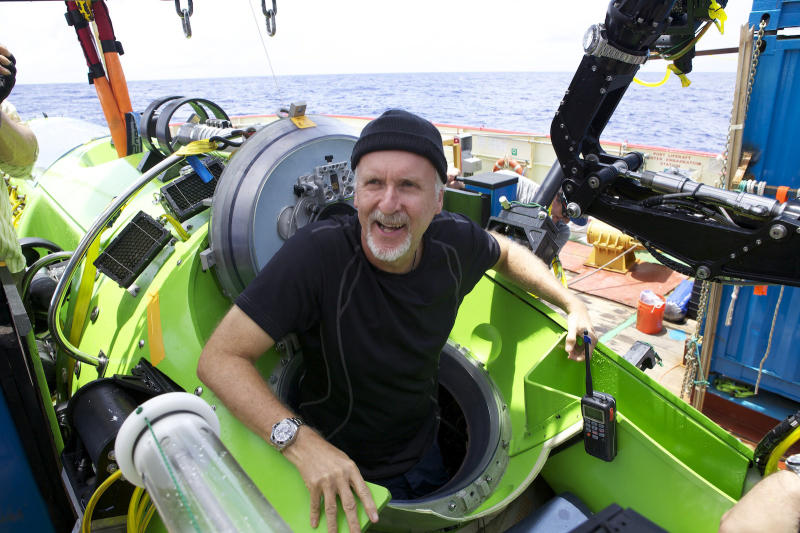
What do you do when you are the most successful filmmaker in recent history? You dive to the deepest point on the planet. Duh.

James Cameron was born in Canada and moved to the U.S. in the early 1970's, majoring in physics at California State University. After school, he quickly rose in the film industry, making such well known films as The Terminator (1984), Aliens (1986), The Abyss (1989), Terminator 2: Judgement Day (1991), True Lies (1994), Titanic (1997), and Avatar (2009). That's just to name a few. These movies have broken all kinds of box office records and racked up several Academy Awards. Today, he is one of the most sought-after directors in Hollywood. As you may have noticed, many of Cameron's films have water or the ocean as a central theme, and many of them use machines as an important plot point or weapon. To say that Cameron has a fascination with the ocean and it's depths would be an understatement. He is an avid explorer, with 72 submersible dives to his credit.

“I’ve always dreamed of diving to the deepest place in the oceans. For me it went from a boyhood fantasy to a real quest, like climbing Everest, as I learned more about deep-ocean exploration and became an explorer myself in real life. This quest was not driven by the need to set records, but by the same force that drives all science and exploration … curiosity. So little is known about these deep places that I knew I would see things no human has ever seen. There is currently no submersible on Earth capable of diving to the ‘full ocean depth’ of 36,000 feet. The only way to make my dream a reality was to build a new vehicle unlike any in current existence. Our success during seven prior expeditions building and operating our own deep-ocean vehicles, cameras, and lighting systems gave me confidence that such a vehicle could be built, and not just with the vast resources of government programs, but also with a small entrepreneurial team. It took more than seven years to design and build the vehicle, and it is still a work in progress. Every dive teaches us more, and we are continuing to improve the sub and its systems daily, as we move through our sea trials.” —James Cameron
Most recently, Cameron has made history with National Geographic's DEEPSEA CHALLENGE Expedition. DEEPSEA CHALLENGE, a joint scientific expedition by Cameron, National Geographic and Rolex to conduct deep-ocean research and exploration. Scripps Institution of Oceanography is the primary science collaborator, working explore and study the deep sea and its marine life. It has been 50 years since man has descended 35,800 feet (10,912 meters) to the deepest point in the ocean, known as the Challenger Deep in the Mariana Trench. With a team of engineers, Cameron co-designed a submersible that incorporated the newest technologies, designs, and material available that could carry a human pilot to the deepest sites in Earth's oceans and perform work with significant bottom time for research activities. This submersible was also designed to dive repeatedly to gather data, samples, and imagery of the deep oceans.

The submersible was launched into the Pacific Ocean some 200 miles (322 km) southwest of Guam on Monday, March 26. The voyage down to the Challenger Deep took 2 hours and 36 minutes, the stay at the bottom lasted about three hours, and the return trip took only 70 minutes. During the time at the bottom they were able to collect research samples, still photographs, and moving images. This amazing trip makes James Cameron the first person since 1960 to reach the very bottom of the world. And he wouldn't be the filmmaker he is without documenting this for a new 3-D feature film, which will be broadcast on the National Geographic channel in the future. Look for it. I know I will!

One of the first images from the expedition

Visit National Geographic's DEEPSEA CHALLENGE website for more information, updates, videos, and great pictures.

Read more at National Geographic's Press Release Detail about the expedition.

Scripps Institution of Oceanography's webpage about the dive.

(images via the DEEPSEA CHALLENGE website and Live Science)

Friday, November 18, 2011

Name the Array Contest


Radio astronomy is a subfield of astronomy that studies celestial objects that emit radio waves. This type of astronomy uses large radio antennas or radio telescopes that can be used either singularly or as multiple linked telescopes utilizing radio inferometry and aperture synthesis techniques. It is incredibly useful because radio waves penetrate dust, which can obstruct visible light, and see objects which would otherwise be invisible to us. Astronomers can observe such things as the Microwave Background Radiation (the remnant signal of the birth of the universe in the Big Bang), the generation of galaxies, black holes, and much more.

The National Radio Astronomy Observatory (NRAO) is a facility of the National Science Foundation (NSF). The NRAO was founded in 1956 and provides radio telescope facilities open to all astronomers regardless of institutional or national affiliation. One of the most famous and widely used of their facilities is the Very Large Array (VLA) located on the Plains of San Agustin, about 50 miles west of Socorro, New Mexico, USA. You may recognize it if you have seen the movie Contact. The VLA consists of 27, 230-ton, 25-meter diameter dish antennas that together comprise a single radio telescope system. Over the past few years, the original 1970's vintage electronics that run the telescopes has been replaced with state-of-the-art equipment, expanding the VLA into the Expanded Very Large Array (EVLA) by 2012. This new equipment increases the telescope's technical capabilities by factors of as much as 8,000!

And now this new facility needs a new name!

The NRAO is currently seeking ideas for a new name for the VLA and they want you to submit your ideas. You can enter a free-form name, or a word or phrase to come as a prefix before "Very Large Array," or both. Submissions will be accepted until 23:59 EST on December 1, 2011. The new name will be announced at NRAO's Town Hall at the American Astronomical Society's meeting in Austin, Texas on Tuesday, January 10, 2012.

Visit the Name the Array webpage to learn more and submit your ideas!

(image by Richard Ryer and from panoramio.com, selected for Google Earth ID: 633587)

Thursday, October 27, 2011

Space Junk? Meet Lasers


"Back in the 60's, I had a weather changing machine that was, in essence, a sophisticated heat beam which we called a 'laser.' Using these 'lasers,' we punch a hole in the protective layer around the Earth, which we scientists call the 'Ozone Layer.' Slowly but surely, ultraviolet rays would pour in, increasing the risk of skin cancer. That is unless the world pays us a hefty ransom."

Perhaps I should have titled this post the Alan Parsons Project?

Anyway, I was looking for a specific article I had seen written up in Wired Science and my cursor would not allow me to scroll further than an article about frying space junk with lasers. Smart cursor.

As with everywhere else we've been we leave stuff behind. Space is no exception. Over the past 35 years we have created several hundred thousand pieces of space debris larger than 1cm in the 400-2000km altitude low Earth orbit (LEO) band, their density reaching a peak in the 800-1,000km altitude range. Small, untracked debris is hazardous to space vehicles, and although larger debris are less numerous and trackable they are also dangerous. Not to mention that what goes up may eventually come down. Recent events with a falling satellite have illustrated that. As someone who lives on the down area I may have cause to be concerned. But what do do about it?

A new paper published Oct. 17 on arxiv suggests a solution. First, categorize the debris into threat categories. The authors present an equation that calculates the interval between collisions because while the debris growth rate is reduced by removing large objects that, when hit, produce small objects and the small objects are a greater threat numerically.

Next, create a method to get rid of said debris. Up to now many methods have been proposed to rid LEO of space junk including grappling the objects, attaching deorbiting kits, deploying nets to capture objects, attaching an electrodynamic tether and deploying clouds of frozen mist, gas or blocks of aerogel in the debris path to slow it. The problems with these techniques are the expense (costing about 27 million dollars per large object!), the accuracy, and the difficulty.  So what do you do? Lasers!

Laser-based methods can be divided into three categories: (1) low laser intensity which doesn't destroy but instead divert the debris, (2) higher laser intensity which heats to ablation with continuous (CW) lasers, and (3) pulsed laser orbital debris removal (LODR) which uses a mirror to focus a repetitively pulsed, high intensity laser on an object. The first method is less efficient, its effects are comparable to the uncertain effects of space weather and sunlight, and it does not address the debris growth problem. The second method involves slow heating of tumbling debris which gives an ablation jet whose momentum contribution cancels itself out, and the heating causes a messy melt ejection that adds to the debris problem. Therefore the authors recommend the third method.

If you read the entire 37 page paper then you will see that the authors make a good case for the pulsed laser space junk removal system. Overall, it costs the least per object, can deal with both small and large objects, can handle tumbling objects, can prevent collisions, and the target access is at the speed of light, redundant and agile. Not to mention that it will require international cooperation to build and operate, and the authors make the point that this cooperation will "avoid concerns that it is a weapon system." So I guess it has that forcing everyone to play nice factor going for it.

Summary: Lasers disintegrating space junk = Really cool.

Here's the paper:
Phipps, Claude R. (2011) Removing orbital debris with lasers. (arxiv:1110.3835)

And here is the Wired Science Story:
Space Junk Crisis: Time to Bring in the Lasers

Also check out:
Space Junk Problem Reaches 'Tipping Point' from Discovery News

"Mini Me, stop humping the 'laser'. Honest to God! Why don't you and the giant 'laser' get a fricken room for God's sakes"

Sorry, couldn't help it; I just had to throw in one last Dr. Evil quote.

Wednesday, October 5, 2011

Faster Than a Speeding Photon


I've been avoiding posting about this story because I'm not sure I'm totally on board with the results. But to say it has caught the news media and Internet on fire would be an understatement. So I've decided to go for it: Let's review the paper about neutrinos going faster than the speed of light.

Physics, especially particle physics, can get really complicated really fast. So, I think, to understand the significance of this finding you have to know some basics about fundamental particles. For that I suggest you go back and read my So Quarky post from back in 2010. Neutrinos are one of these fundamental particles belonging to the class of particles called leptons. They have no charge which means they are not affected by the electromagnetic force; they are only affected by the weak subatomic force. They are able to pass through large amounts of matter without being affected. Since it has mass, although extremely tiny, it is affected by gravity but that is the weakest of the forces. Neutrinos come from several sources. Most of them are left over from the big bang and make up part of the cosmic microwave background while others are produced in stars, beta decay, etc. We can also generate them in physics laboratories by colliding high energy particles into fixed or moving targets.

The speed of light is 299,792,458 meters per second (186,282 miles per hour). According to Albert Einstein's theory of special relativity, the speed of light (c) in a vacuum as a physical constant, a maximum speed at which all energy, matter, and information in the universe can travel. The speed of light is the speed of light no matter the motion of the source or the inertial frame of reference of the observer. It is the ultimate limit, the fastest a particle can move. So what happens when an experiment records a particle going faster than the speed of light?

The Oscillation Project with Emulsion-tRacking Apparatus (OPERA) lies 1,400 meters underground in the Gran Sasso National Laboratory (LNGS) in Italy. It was designed to "perform the first detection of neutrino oscillations in direct appearance mode in the νμ→ντ channel, the signature being the identification of the Ï„− lepton created by its charged current (CC) interaction." Um, ok. In addition to this main goal, OPERA is also suited accurately determine neutrino velocity though the measurement of the time of flight and distance from the source. CERN (the European Organization for Nuclear Research), 730km away, fires a beam of neutrinos through the earth to OPERA, a 2.43-millisecond trip for a photon. A total of 16111 events were collected over three years. They found that, on average, the neutrinos arrived 60 nanoseconds faster than expected if they were traveling at the speed of light.

Whoa.

Now take a couple of logical steps past that. If neutrinos go faster than the speed of light (even a little bit) then are we getting into the realm of tachyons and time travel? Possibly.

But wait...don't throw Einstein's theories out the window and don't start building that time machine just yet.

The big question now is whether these scientists have actually discovered particles going faster than the speed of light or if there is some type of error in their experiment that is making the velocity look artificially short. After all, this is an extremely sensitive measurement. We're talking unreacting particles that are lighter than an electron and time measured in nanoseconds. Right now there are all sorts of responses being talked about an published on this topic.

The consequences of these results would be huge, and one of the things I like about this experiment is the way in which it was presented. They didn't just announce "We've broken the speed of light!" The authors put the information out there -- here are our results -- asking scientists to independently confirm or deny these results and/or offer up explanations as to why these results were obtained.

What do you think?

Here is the prepublished paper:
Adam, T. et al. (2011) Measurement of the neutrino velocity with the OPERA detector in the CNGS beam. High Energy Physics - Experiment ( arXiv:1109.4897v1)

I also recommend reading through a few of these articles as they offer some great views from other physicists:
Science Magazine: Neutrinos Travel Faster Than Light, According to One Experiment
Nature News: Particles Break Light-Speed Limit
The Guardian: Faster Than Light Particles Found, Claim Scientists
Scientific American: Faster-Than-Light Neutrinos? Physics Luminaries Voice Doubts
The New York Times: Tiny Neutrinos May Have Broken Cosmic Light Speed
Wired Science: Can Neutrinos Move Faster Than Light?
New Scientist: Faster-Than-Light Neutrinos? New Answers Flood In


(image from physics.ubc.ca)

Monday, July 18, 2011

Epic 3D Printing

I haven't posted anything techie in a while and this video really impressed me. I thought I knew what 3D printing was until I saw this.

"3D printing is a form of additive manufacturing technology where a three dimensional object is created by laying down successive layers of material. 3D printers are generally faster, more affordable and easier to use than other additive manufacturing technologies. 3D printers offer product developers the ability to print parts and assemblies made of several materials with different mechanical and physical properties in a single build process. Advanced 3D printing technologies yield models that can serve as product prototypes."

Thursday, July 14, 2011

Atlantis Rises: The Last Launch of the Space Shuttle

I lived in Orlando, Florida for a while in the early 2000's. I remember sitting on the east-facing porch of my second floor apartment and even though we were 50 miles west of Cape Canaveral we could watch the space shuttle launch. And for hours afterwards you could see the plume trail it left behind in the atmosphere. Occasionally we would make the hour drive out to the coast and watch it up close. What I remember most is standing across the water and literally feeling the wave of sound rolling across the water towards us, like a freight train. It was awesome in its magnitude and inspiration.

The space shuttle Atlantis lifted off July 8 on the final flight of the shuttle program for the STS-135 mission. Unfortunately, I was not able to drive down to see it or sit on my porch like I used to and watch the shuttle go up and up as it curved out of our atmosphere. But, in the age of the Internet I could go online and watch it live as well as find any number of videos showing the launch. They don't quite get the awe-inspiring feeling across like seeing it live but they are still pretty good. Here are a couple that I found to be particularly good.

This is a video taken by David Gonzales, Kurt Johnson and Mike Deep from the Kennedy Space Center Press Site. They used multiple cameras along with a high definition stereo audio recording device to capture the sights and sounds of the launch. This is probably the closest you can get to with out actually being there.


This is a video of the launch from Atlantis' SRB camera. These are the cameras mounted on the shuttle's solid rocket boosters.


Story via UniverseToday

Sunday, May 15, 2011

Flexible Furniture

When I see a link for a website called FlexibleLove I want to make sure my computer's virus protection software is up-to-date and am wary about opening it at work. In this case, though, it is actually a pretty cool site. This is a company that sells expandable furniture...weird and cool all at the same time. The furniture has an accordion-like design with a honeycomb structure and is made from recycled paper, recycled wood paste, and it is produced using pre-existing manufacturing processes in order to reduce environmental impact. The name "FlexibleLove" is derived from "flexible love-seat" because it can expand to hold anywhere from one to sixteen people. Crazy!

Check it out: http://www.flexiblelove.com/


Monday, May 9, 2011

Solder Blob

If you've ever built a power board, or the like, then you'll find this comic particularly great. It is the real circuit diagram.


(via xkcd)

Thursday, April 28, 2011

Good Radiation

This video is from cadamole, the artist who wrote A Biologist's Mother's Day Song. I'm pretty much loving everything this guy posts and this rap about public radio is no exception. As I do a lot of tedious lab work I listen to a lot of NPR, if you do too then you will love love love this!

Sunday, March 20, 2011

Messenger to Mercury


The Messenger has arrived! As of 9:10 p.m. EDT on Thursday March 17th, NASA's Messenger spacecraft entered orbit around the planet Mercury and as of 9:45 p.m. rotated towards Earth and started transmitting data. MESSENGER stands for MErcury Surface, Space ENvironment, GEochemistry and Ranging. The spacecraft was launched August 3, 2004 from Cape Canaveral, Florida with the mission to "unravel the mysteries of planet Mercury." Messenger has spent the last years circling through the inner solar system, performing flybys and gravity assists of Earth, Venus, and even Mercury itself until finally settling into orbit around the innermost planet. The spacecraft carries several instruments that will take images and measurements of the planet:

The Mercury Duel Imaging System (MDIS) consists of wide-angle and narrow-angle imagers that will map landforms and topographic features. The Gamma-Ray and Neutron Spectrometer (GRNS) will detect gamma rays and neutrons that are emitted by radioactive elements on the surface and use that to map relative abundances of different elements. The Magnetometer (MAG) will map Mercury's magnetic field and magnetized rocks in the crust. The Mercury Laser Altimeter (MLA) will beam light to the planet's surface and a sensor will collect any reflected light in order to gather further information about topography. The Mercury Atmospheric and Surface Composition Spectrometer (MASCS) is an instrument that is sensitive to light in the infrared to ultraviolet range in the spectrum and so can measure the abundances of various atmospheric gases and minerals on the surface. The Energetic Particle and Plasma Spectrometer (EPPS) will measure the composition, distribution, and energy of charged particles in the magnetosphere. And finally, the Radio Science (RS) instrument will use the Doppler effect to measure changes in spacecraft's velocity and use that to study Mercury's mass distribution, including variations in the thickness of the crust.

Mercury is the planet closest to the Sun. It is small and extremely dense with a lot of metals, a thin crust, and a thin atmosphere. It is thought to have formed out of the solar nebula, the disk of gas and dust around the newly formed Sun, but it is not known whether or not the planet formed in the location that it is today. It is odd that one of the densest objects in the solar system formed so close to the Sun. There are several ideas out there to explain why. Because Mercury resembles a planet core rather than a whole planet some think it was originally a larger object that suffered an impact that knocked part of the surface off and/or required the planet to reform. Others think that the very active early Sun blasted off the crust early in Mercury's history. Despite this possibly violent possible history, the planet has formed a thin atmosphere. Now we're not talking rain, clouds, wind etc. like we are used to thinking of on Earth. Mercury's atmosphere is more like scattered particles that only occasionally come in to contact with one another, it is more like a gas layer close to the surface, or an "exosphere." That surface has a cracked, scorched look to it. It is thought that the planet's iron core froze (or solidified) and contracted. To visualize this think about a balloon tightly covered by a piece of cellophane, if you let air out of the balloon it creates space between itself and the cellophane, but the cellophane still wants to cling to the surface of the balloon and so develops cracks or folds in order to stay in place. This theory says that Mercury's crust did something similar when the core solidified (note: the presence of a magnetic field suggests that at least part of the core may be liquid). Add to that the impact craters similar to the ones you see on our Moon and you start to get a picture of the planet. Oh yeah, and did I mention the possibility of ice? Uh-huh, the planet closest to the Sun may have ice at its poles. The rotational axis is straight, not tilted like Earth's, and so the poles never see sunlight. Barring other factors, no sunlight equals very cold and that means there could be ice. Neat.

As you can tell, there's a lot of ideas and theories out there about Mercury. Our lack of information mainly comes from the fact that Mercury is very difficult to observe. Think about it. It is really close to the Sun, and the massive amount of light coming from the Sun tends to obscure a lot of the planet's features. If you try to observe it when the Sun is below the horizon, at night, you will find that the planet never gets more than 28 degrees above the horizon. Then add the fact that the planet is tidally locked to the Sun. Tidal locking is when an object takes as long to rotate around its axis as it takes to complete its orbit, just like our Moon to us (a 1:1 resonance). In the case of Mercury, the planet does not have an exactly circular orbit and actually rotates three times for every two orbits around the Sun, in a 2:3 resonance (a year is only one and a half days long!). That tidal locking means that Mercury is always presenting the same side to us. From the two high-speed flyby's by Mariner 10 spacecraft in 1974 and 1975 we have some images, but only of one side of the planet.

It is likely that Mercury is the key to us unlocking the mechanism of terrestrial planet evolution. Messenger will gather data that will help answer the questions of why is the planet so dense, what is its geologic history, what is the nature of the magnetic field, what is the structure of the core, what volatiles (gases etc.) are present and important, and if there is ice at the poles.

But Messenger will not be the last spacecraft to visit Mercury. The European Space Agency (ESA) in a joint mission with the Japanese Aerospace Exploration Agency (JAXA) will be launching the BepiColombo in 2014 that will arrive at Mercury in 2020. This mission will further study the planet's evolution, form, interior, structure, geology, composition, atmosphere, magnetosphere, and polar regions. Find out more about this mission at their website: http://sci.esa.int/science-e/www/area/index.cfm?fareaid=30

Visit these Messenger websites to learn more about the spacecraft, the mission, and up to the minute information and images:
http://messenger.jhuapl.edu/
http://www.nasa.gov/messenger


A few news stories about the newly attained orbit:
http://www.universetoday.com/84195/success-messenger-first-spacecraft-to-orbit-mercury/
http://www.sciencedaily.com/releases/2011/03/110317232139.htm
http://www.iop.org/news/11/feb/page_48432.html
http://www.usatoday.com/tech/science/columnist/vergano/2011-03-18-Mercury-MESSENGER-gravity_N.htm
http://www.nytimes.com/2011/03/19/opinion/19sat4.html
http://www.timeslive.co.za/world/article976680.ece/Nasa-Messenger-makes-it-to-Mercury

Learn more about Mercury:
http://solarsystem.nasa.gov/planets/profile.cfm?Object=Mercury
http://www.universetoday.com/13943/mercury/
http://www.astronomycast.com/astronomy/episode-49-mercury/
http://science.nationalgeographic.com/science/space/solar-system/mercury-article.html
and the Mariner Program:
http://history.nasa.gov/mariner.html
http://www.jpl.nasa.gov/missions/missiondetails.cfm?mission=mariner10

(image from nasa.gov)

Sunday, February 13, 2011

Blogging Science


Blogging about science is becoming a more and more popular endeavor. Considering all of the fantastic science being conducted all over the world, that can hardly come as a surprise. As the pace of improving technology increases and the public's appetite for information skyrockets, blogs have become an increasingly important medium to share information. After all, you are reading a science blog now, right? And, as younger and more Internet savvy individuals come into the science field you are starting to see more blogs written by scientists themselves. This can be both a good and a bad thing, from the scientist's prospective.

With the hiring pool filled to overflowing with recently graduated PhD's and postdocs, many departments are now looking at other aspects of a candidate's accomplishments in addition to teaching history and publication rate. One of those aspects is a good blog. Why? Well, think about your typical undergraduate student - always has a cell phone, on the Internet almost constantly, and very socially conscious. A blog offers a way for undergraduates to read and get excited about science. It also offers researchers an avenue to present and explain scientific findings to the public.

However, blogs, being the very public media that they are, can be both a help and a hindrance to a scientist's career. It's all about how said scientist goes about it and how the university they work at views it. Let's break it down into two categories by which universities are often classified: nonresearch institutions and research-intensive institutions. The first values blogs as a nonresearch activity that supports the traditional academic activities of teaching and outreach. Activities that pertain to and are valuable to the goals of their institution. Research-intensive institutions tend to view blogs at best as a harmless hobby and at worst as a liability.

The good about science blogging:
  • Reach a wide audience
  • Present research papers of all kinds, including ones that don't get a lot of attention or citing
  • A source of public outreach
  • A way to present individual research
  • A way to illustrate the types of research conducted at a particular institution
  • Have a "broader impact" (a term used by funding agencies)
  • Networking
Things to watch out for if you have or decide to start a science blog:
  • It is time consuming and may take away from research
  • Do not blog about unpublished research
  • Present but don't criticize the research of other scientists
  • Limit your blogging to research you admire to avoid negative blogging
  • Be delicate when blogging about your own research
  • Avoid controversial subjects like politics, religion, or academic controversies
  • And a pseudonym might not be a bad idea
Overall, scientific blogging is considered to be a good thing as long as it does not take away from the job of conducting science, and as long as a scientist takes certain precautions. Personally, I find it a way to keep myself up-to-date and reading the recent scientific literature and something to have fun with.

On that topic, if you read my blog frequently, or even semi-regularly then please hit the subscribe button -->
Here is the article from Science's Career Magazine that I based this post on:
http://sciencecareers.sciencemag.org/career_magazine/previous_issues/articles/2011_01_28/caredit.a1100007

They also reference ScienceOnline 2011, a meeting on Science and the Web, that took place last month in Research Triangle, North Carolina, USA. This was a meeting of scientists, students, educators, physicians, journalists, librarians, bloggers, programmers, and others to discuss how the Web is changing the way science is communicated, taught, and conducted. You can read more about the meeting here:
http://scienceonline2011.com/

Science Online London 2010 was a very similar meeting, with very similar goals, held back in September of last year in London, England. You can read more about the meeting here:
http://www.scienceonlinelondon.org/

(image from web.utk.edu)

Monday, December 20, 2010

Body by Google


Google. Love Google. It does so much, including powering this blog. They are known for their great mapping technologies such as Google Earth. Now they tackle a new mapping challenge: The human body. Last Thursday marked the release of Body Browser.

Body Browser uses 3D graphics application programming interface WebGL running within a browser to create a three-dimensional model that allows users to zoom in and out of the human body, remove layers, and generally explore. It is searchable and clickable, giving all sorts of info on how the body is put together.

Body Browser doesn't require Java or Flash, but you will need a browser that supports WebGL. Google recommends using the most recent version of Chrome, but Safari and Firefox/4.0b1 work as well. Body Browser is still in beta and has not been officially released, but users are able to try it out and report problems and bugs. So keep an eye out for this program to become fully operational.

Enjoy!

Here's the Body Browser site: http://bodybrowser.googlelabs.com/

http://www.informationweek.com/news/storage/virtualization/showArticle.jhtml?articleID=228800812&cid=RSSfeed_IWK_All#

http://www.pcmag.com/article2/0,2817,2374438,00.asp

http://www.pcmag.com/article2/0,2817,2374462,00.asp

http://healthland.time.com/2010/12/17/google-takes-a-peek-inside-your-body/

http://blog.chromium.org/2010/12/chrome-is-ready-for-business.html
Related Posts with Thumbnails