Showing posts with label biomechanics. Show all posts

Thursday, August 20, 2015

Falling with Style: Controlled Gliding in Spiders


Sometimes I read a paper because the methods catch my eye. I can just imagine some scientists sitting around a table with a beer and saying, “I wonder what would happen if we just dropped a bunch of spiders from the tops of trees.” An article published online yesterday did just that.

Barro Colorado Island is a man-made island is located in Gatun Lake, created by filling of the Panama Canal. It is covered in tropical rainforests, and its inhabitants have been studied extensively. It would be a mistake to look at a forest as only ground habitat. The canopy supports a tremendous abundance of life, particularly arthropods. These critters are particularly tasty to predators and must find a way to escape within their decidedly hazardous habitat that is located over 90 feet (30 meters) off the ground. Falling is a bit of a risk. But what if you do fall? You could land in the understory or on the ground which, if it doesn’t kill you, is both unfamiliar and full of predators. To avoid this potentially lethal scenario, many wingless arthropods have developed the ability to orient their bodies (via visual cues, appendages, and other structures) such that they are more likely to fall towards tree trunks.

The genus Selenops is a large and common group of nocturnal spiders. They are easy to find and collect, often hiding under bark or in crevices. The researchers went out into the forests and collected a bunch of these spiders. The spiders were then weighed and photographed. The images were then analyzed for the horizontally projected areas of different segments and appendages. Then these data were put together to give “effective wing loading.” Here’s where we get to the fun part. The spiders were put into individual plastic cups and taken up into the canopy. The cups were held at a known distance from a tree trunk, inverted and tapped to release the spider. Geronimo! These drop tests were filmed at 60 frames per second so that glide index (ratio of horizontal distance from the tree trunk to the total distance traveled) could be calculated. The videos also allowed for the measurement of how the legs were being used to maneuver. The spiders were also scored in terms of their performance, either directly reaching the tree, indirectly or irregularly gliding towards the trunk, or failing completely and landing elsewhere.


Most of the spiders had a successful, directed decent without the aid of draglines or balloons. They fall several meters and then glide to a trunk. During this fall, they were observed to adopt body postures that orient their bodies to descend head first with the forelegs out to the side and slightly forward and the rest of the legs out and back. This foreleg asymmetry was shown to significantly change body heading meaning that they are using their legs to control their glide trajectory. Also, glide index was shown to decrease with increasing body mass. They hypothesize that this negative relationship means that larger spiders must accelerate under gravity to airspeeds where aerodynamic lift becomes significant relative to body weight.

This is an interesting result because other arachnids do not show it. These spiders have developed the ability to control their glide trajectory. This means that they have evolved novel mechanisms of body righting and maneuvering. Gliding spiders….cool.


ResearchBlogging.orgStephen P. Yanoviak, Yonatan Munk, & Robert Dudley (2015). Arachnid aloft: directed aerial descent in neotropical canopy spiders J. R. Soc. Interface, 12 : 10.1098/rsif.2015.0534

(image via Toy Story screencap)

Tuesday, May 28, 2013

Staying Sticky, a Frog's Journey


Climbing is good. It allows for gaining access to habitats that would otherwise be unavailable. And while this access is important (otherwise, why climb in the first place?), equally important is not falling to a gruesome death. This means that your method of adhesion to the surface you are climbing needs to be effective. For example, on rough surfaces, friction pads and claws work rather well. Smooth surfaces and overhangs offer a bit more of a challenge. If you want to climb one of these surfaces you have a couple of adhesion options – dry and wet. If you are a creature that chooses dry adhesion, like a gecko, then you have toe pads covered by large numbers of finely branching setae, each ending in a flattened spatula. When these spatula come into close contact with a surface van der Waals forces allow for the sticking. You remember van der Waals forces from physics class right? Those are the attractive forces that hold together molecules in solids. If you are a creature that chooses wet adhesion, like tree frogs, then you secrete mucus from glands ending on the surface of your toe pads. This mucus makes an adhesive bond by a combination of capillary and viscous forces.

Frog toes. They’re squishy, they’re sticky, they’re cute (feel free to say that in a sing-songy voice if you haven’t already). If you look very closely, you will also see that they have a hexagonally patterned surface. In between the pad epithelial cells there are mucus-filled channels that spread the mucus over the surface of the pad, creating a thin layer that allows for wet adhesion to a surface.

Enter a new problem: How do you keep your toe pads clean? Think about any sticky surface you know. Now think about putting that sticky surface on anther surface. What happens? It gets really dirty really quickly, causing it to be less sticky. So now you are a frog that needs sticky feet to climb, and to do that you need to keep your toe pads clean so that they remain sticky. You can’t really groom your toe pads when you are using them and molting/shedding isn’t frequent enough to shed the dirt (or “contamination”). The answer: a passive self-cleaning mechanism.

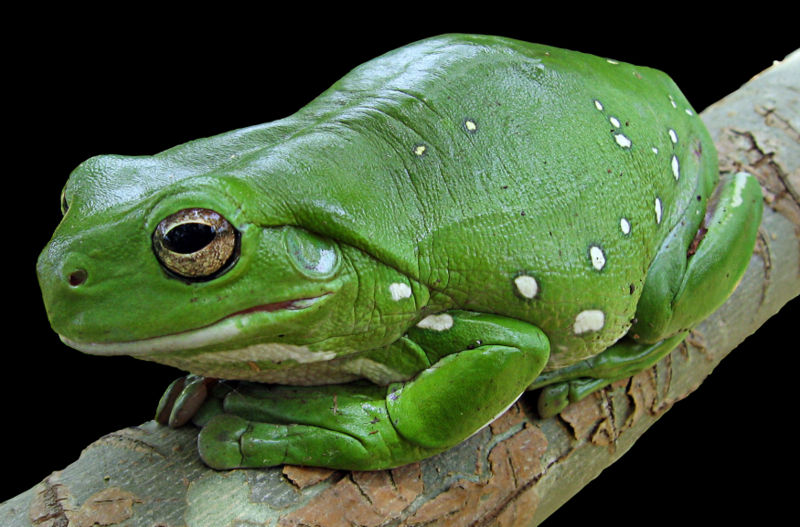
A study published in The Journal of Experimental Biology looks at this passive self-cleaning mechanism in frogs, using both single-toe experiments and whole-animal experiments. Their study animal was the Australian green tree frog (Litoria caerulea), also known as White’s tree frogs (and that dough-boy kind of cute if I must say *grin*). They used five frogs in each of their experiments, first washing them and carefully blotting them dry. (An aside, how do you get the job of tree frog washer?) For the purposes of a lab experiment, they had to create a contaminant. For this they used very small glass beads arranged in a single layer on a glass coverslip for the single toe experiment and as a thin layer in a Petri dish for the whole-animal experiment. For the single-toe experiments, the researchers used a custom-built force transducer consisting of the glass coverslip (the surface attachment) connected to a bending beam and then measured the forces in two dimensions – lateral drag and dab (simply pressed against the surface) – with and without beads. For the whole-frog experiments the animals were put on maneuverable platforms to see at what angles they began to slip and/or fall with and without beads. These experiments allowed them to calculate shear (friction) force and the normal (adhesive) force. Ever wonder when you are going to use trigonometry again? Well, if you know the body weight of the frog and the angle of the slip/fall you can calculate these forces. You're high school math teacher would be proud.

There were computer programs and statistics and equations (lots of equations) that I won’t go in to (as usual, you’re welcome). What they found is rather interesting. The whole-animal experiments showed that the toe pads of frogs will self-clean over time. With the first step, when the toe pad becomes contaminated, the adhesive and friction forces decrease, but then they recover such that by the fourth step 91.9 percent of the original adhesive forces and 98.5 percent of the original friction forces are back. These experiments also found that the more the toe pad is used the greater the recovery of the contaminated toes for both adhesion and friction forces. That is, a moving frog has cleaner toes than a stationary frog. The single-toe experiments shed more light onto why this is so. In the experiments that included the lateral drag movement, the frog toe recovered its adhesive force after about eight trials. Whereas in the dab experiments, there was little if any recovery (except if the pads were only partially contaminated). It seems that this shearing movement is an important feature of the self-cleaning mechanism, and it is one that is common in walking frogs. Frogs use this type of movement a lot on vertical surfaces and will continually re-position slipping pads to incorporate self-cleaning while maintaining adhesion to the surface. When the researchers looked even closer, at the level of pad contact area and the number of glass beads deposited on the glass during each trial, they found a correlation between adhesive force and contact area such that normal stress (adhesive force per unit area) remained constant. Since the number of beads deposited on the glass plate is a measure of self-cleaning, they were able to show a positive correlation between force recovery and contact area, particularly in the drag scenario. Essentially, as the toe pad drags along the beads get left behind, or "flushed," in the mucus footprint. Hmmm…mucus flushing doesn't make frog toes sound quite as cute.

ResearchBlogging.orgCrawford, N., Endlein, T., & Barnes, W. (2012). Self-cleaning in tree frog toe pads; a mechanism for recovering from contamination without the need for grooming Journal of Experimental Biology, 215 (22), 3965-3972 DOI: 10.1242/jeb.073809

...and if you have access there are some interesting if hard to see videos in the Supplemental Materials


(image via Wikimedia Commons)

Friday, April 8, 2011

Moving at a Snail's Pace


This post is about slime. Well, it's about moving around in slime. *squish*

Mollusca, or mollusks, is a large and highly diverse phylum of invertebrate animals. Within this phylum is the Class Gastropoda, or gastropods, which include snails and slugs. Generally, gastropods, specifically snails, have an asymmetrically spiral (coiled on one side) shell that functions as a portable retreat. Slugs are almost identical to snails except they lack a shell. The snail and slug body consists of a head, foot, and visceral sac/hump, and mantle (pallium). The head includes a mouth surrounded by one or two pairs of tentacles which often carry eyes and a pharynx containing coarse or fine teeth on the radula (like a tongue). The foot is the main locomotive organ and is usually the part that is visible outside of the shell. On the sole of the foot are mucus glands that secrete the slime that the gastropods crawl on.The visceral sac contains most of the inner organs and the mantle is a tissue fold covering it.

Though snails and slugs have no external extremities they are quite capable of moving around in their environment. Understanding this movement has been of interest to scientists and engineers for some time, even inspiring new classes of robotic movement and adhesive locomotion. It is known that a series of pulses of muscle contraction and relaxation traveling along the central part of the foot's ventral surface allows the snail to move forward, and only forward in terrestrial gastropods. The pulses of muscles are called pedal waves, the regions of the foot between pedal waves are called interwaves, and the distance between the two is called the wavelength. When these waves interact with the mucus secreted by the gastropod propulsive forces are transmitted to the ground. In describing snail locomotion, the number of waves is classified according to their number and direction. They are classified as a single train of pedal waves (monotaxic) or as a two (ditaxic) or four (tetrataxic) series of waves. It is also known that the crawling speed is directly proportional to the speed and frequency of the pedal waves.

A 2010 study in the Journal of Experimental Biology takes a look at the mechanism by which the propulsive forces are generated during gastropod locomotion. To accomplish this the researchers used a newly developed force-cytometry method where they calculate the spatial and temporal distribution of pedal forces from measurements of the deformation produced by the snail when it contacts a surface of known elastic properties. This allows them to study the movement is great detail. They can measure the horizontal traction stresses to the surface underneath the snail/slug without any interference with the animal's body. Neat. The study also analyzes the kinematics (motion without reference to the forces causing it) of the pedal waves and its significance of the generation of traction force. They did this to find the relationship between speed/wavelength and velocity, to determine if the waves maintain a constant speed/wavelength, to find how the snail accelerates and decelerates, and to see if a change in speed is accomplished by increasing the number of waves or by varying the speed/wavelength.

Fig. 1. from the paper showing the ventral surface of the banana slug
That all sounds very...complicated. So how do you measure the pedal waves of a snail's foot? If you know any biomechanists then you know they like to do two things - put animals on treadmills and put animals on transparent surfaces. In this case they tested banana slugs (Ariolimax californicus and A. buttoni), grey field slugs (Deroceras reticulatum), and garden snails (Helix aspersa) by placing them on transparent surfaces, illuminating them, and then recording them crawling with digital cameras. Turns out that if you illuminate the body in different ways you can get different information about movement. Add all of those ways together and you get a 3D reconstruction of the snail's foot as it moves.
The researchers found that when a snail/slug moves forward there are alternating pedal wave and interwave regions propagating from the tail forward to the head, but the interwaves remain stationary with respect to the ground. That result wasn't all that surprising, and agreed with previous studies. When they looked a little closer at the high-resolution images they found that the organization of the waves was not symmetrical and did not move at a constant speed. They observed steady wave acceleration followed by abrupt deceleration, a variable speed of pedal waves which modulated the magnitude of stresses under each wave. This was unexpected and observed in more than one of their test species, suggesting that the pattern is mechanically relevant to locomotion. They also found that the net forward force was generated beneath each stationary interwave. This is where the animal is pressing the foot against the ground and then pulling it backwards, propelling the body forwards. The foot is actually lifted during the pedal waves. Another result showed that that the crawling speed increased with pedal wave frequency. Not all that surprising, have more waves then move faster. And the mucus, we can't forget the mucus. This study's experiments showed that the slugs were able to move themselves over very thin threads of mucus without changing the pedal wave pattern or frequency. This suggests that the amount of pressure applied by the foot doesn't really matter for propulsion. Considering the rugged surfaces that snails and slugs move on that is not all that hard to believe.

The take home message? Mucus is helpful but it is the muscle movements that allow snails/slugs to crawl.

Read the study here, and there are videos in the supplemental materials:
Lai, J. H., J. C. del Alamo, J. Rodriguez-Rodriguez, J. C. Lasheras (2010) The mechanics of the adhesive locomotion of terrestrial gastropods. Journal of Experimental Biology: 213(22), 3920. (DOI: 10.1242/jeb.046706)

Tuesday, December 7, 2010

Falling with Style

Its been a little while since I've posted anything. I suppose that's what the "semi-frequent" part of my blog description really means. So for the next couple of posts not only am I going to post them in rapid succession but they will also be slightly older stories. But, I figure, cool science is always cool science and so will allow myself to get away with it.

This story caught my eye because (1) I attended a talk by this researcher when I was in grad school and (2) it is about flying snakes.

You didn't know there were flying snakes? Well, then you are in for a treat, my friend, a real treat. Flying snakes or flying tree snakes belong to the genus Chrysopelea (family Colubridae) which can be found in Southeast Asia, India and southern China. Despite its name the snake doesn't actually fly. When they launch themselves off a tree they flatten their bodies and undulate to glide to their destination. Basically its body becomes like a big wing ideal for gliding.

The Paradise Tree Snake (Chrysopelea paradisi) is the most commonly studied of this genus. This snake is brightly colored, with a black body covered from head to tail with a yellow spotting pattern that at times can look stripped and has 5 yellow (sometimes orange) bars that span its width. It is native to the tropical forests of southern Thailand, Peninsular Malaysia, the Philippines, Singapore, and Indonesia. The vegetation in these forests can be quite diverse, including tropical broadleafed species and evergreens with little to no understory. Its diet consists of arboreal reptiles and amphibians (lizards, frogs, etc.) as well as small birds and even bats. Add together habitat and hunting and you can probably start see why this snake needs to fly.

A Virginia Tech researcher, John Socha, studies the kinematics of these snakes. He published a short article in Nature in 2002 (and a similar one in The Journal of Experimental Biology in 2005) where he looked at the full three-dimensional gliding trajectory of these snakes. First, in an open field, he built a 10 meter high tower/platform with a horizontal branch extending from the top. Then he carried his snakes to the top of the platform and videotaped and photographed them jumping off the branch and gliding to the ground. Besides the flying snake (which is obviously so very cool) my favorite part is the undergrad let's-call-them-lackeys running to get the escaping snake once it reaches the ground.

Anyway, he found that the snake prepares for take-off by hanging the front part of its body off the branch looped into a J-shape. When the snake jumps it accelerates up and way from the branch, straightening its body and flattening it by stretching out its ribs. The body width of the snake actually doubles and the stretching of the ribs curves the belly into a concave shape. Because the snake is falling it will gain speed and as it does that it will pitch its body downwards and curve into an S-shape. Then the snake starts undulating from side-to-side, starting at the front and moving down the body. This creates lift and allows it to go a further horizontal distance rather than falling straight down to the ground. C. paradisi is very adept at aerial manoeuvring, being able to turn without banking. It can even out-glide other gliders like flying squirrels (Petaurista petaurista) and flying frogs (Rhacophorus nigropalmatus).

Recently there have been some articles in various major news outlets about Socha's new research presented at the American Physical Society Division of Fluid Dynamics meeting in Long Beach, California and a paper accepted for publication in the journal Bioinspiration & Biomimetics. He explains in further detail the gliding motion of these snakes, having developed a mathematical model that explains how they travel such long distances. Basically it takes the gliding description above and explains it mathematically as well as explaining the gliding techniques of other species (mammals, frogs, lizards, etc.). The U.S. Pentagon and the Defense Advanced Research Projects Agency (DARPA) has had a big interest and funded a lot of this research, although they have yet to explain their big interest in the work.

Here is Socha's kinematics paper:
Socha, J.J. (2002) Kinematics: Gliding flight in the paradise tree snake. Nature: 418 (6898), 603–604. (DOI:10.1038/418603a)

This is Socha's flying snake page. It includes some great images and videos of his experiments as well as a fantastic links page to find out more about these snakes. I highly recommend checking it out!
http://flyingsnake.org/

News stories:
http://www.huffingtonpost.com/2010/11/23/flying-asian-snakes-being_n_787534.html
http://news.discovery.com/animals/snakes-flight-aerodynamics.html
http://www.popsci.com/technology/article/2010-11/serpent-science-darpa-wants-know-flying-snakes-secret
Related Posts with Thumbnails