Thursday, September 14, 2017
Join the Litterati: Crowdsourcing for a Litter Free Planet
I've been doing a lot of work in the lab with plastics. They are everywhere! and in all types, shapes, and sizes. A recent meeting with some environmental lawyers on the topic introduced me to Litterati. Litterati started on Instagram in 2012 as a hashtag, and in 2016 was launched as an iOS app.
Today, Litterati is an app that you can use on Apple or Android devices. You use the app to identify, photograph and geotag individual pieces of litter (before you pick up and dispose of them). If the litter has a company/brand label, you can tag that too. This information is added to a global interactive map showing every piece of litter that has ever been uploaded.
So what is the point? First, it provides information on the types of trash that are discarded. To date, plastic is by far the most tagged, followed by cigarrette butts, paper, cans, and then bottlecaps. Next, geotags give information on the places where litter is found and accumulates. This is used to enact change within neighborhoods and communities. Time tags can tell us the times of year that affect littering. Also, companies/brands can be contacted in areas where there products are becoming litter so that they can decide if they can take any actions.
Here is TED by Litterati founder Jeff Kirschner:
You can download the app for FREE from iTunes and Google Play. And check out the Litterati website: https://www.litterati.org/
image via Daily Express
Friday, August 18, 2017
Are You Scientists Excited for the Eclipse?
Monday, August 14, 2017
Will the Ocean Ever Run Out of Fish?
Will the ocean ever run out of fish? To us the oceans are vast. But, in reality, they are a finite resource. Here are two videos for you to consider:
Will the Ocean Ever Run Out of Fish?:
Ending overfishing:
(note: because this was made in 2012, some of the stats are out-of-date, but the concepts still hold true)
Will the Ocean Ever Run Out of Fish?:
Ending overfishing:
(note: because this was made in 2012, some of the stats are out-of-date, but the concepts still hold true)
Wednesday, August 9, 2017
Which Piece of Lab Equipment Are You?
This is a fun little quiz from SciNote. How do your habits in- and outside of the lab reflect your personality, and what piece of lab equipment does that translate into?
Find out: WHICH PIECE OF LAB EQUIPMENT ARE YOU?
I got a scanning electron microscope!
Monday, August 7, 2017
Smells Like Development
A parody of Nirvana's "Smells Like Teen Spirit" all about development and model organisms.
Plants!
Plants!
Thursday, August 3, 2017
The Great American Total Eclipse 2017: What You Need to Know
A total solar eclipse is one of nature's great wonders, and something we should all try to see. On August 21, 2017 there will be a total solar eclipse that can be seen across North America. All 50 U.S. states will be able to see a full or partial eclipse! Why is this such a big deal? Well, besides the whole 50-state thing, the last total solar eclipse in this part of the world happened in 1979, and the next one won't be until 2024. There's a lot of information out there. The overriding theme will be Plan! Plan! Plan! Now, what do you need to know and what can you click to find the best information?
1.) How much will you see?
![]() |
| Image Credit: NASA’s Scientific Visualization Studio |
2.) How long will it last?
3.) Where should you go to see it?
In general, plan for mobility and be flexible. Plan a couple of nearby places and be willing to hop in the car if conditions turn unfavorable beforehand. Also plan for traffic. This is a big event and millions (yes, millions!) of people will be out for it. You don't want to miss totality because you were stuck in your car on the highway. Check this Eclipse Web App for real time traffic data.
Still not sure where to go? Look for events near you. Museums, libraries, zoos, and so many more are planning events. That's my plan. Check NASA's Event Locations and the American Astronomical Society's (AAS) Events and Activities pages to find a place to go.
Don't want to leave your house? That's OK too! NASA Television is offering a special live program, “Eclipse Across America: Through the Eyes of NASA” with real-time coverage of the event from coast to coast. The nearly four-hour program will include images from numerous spacecraft, high-altitude aircraft and balloons, and ground observations. Additionally, the broadcast will include live coverage of activities in parks, libraries, stadiums, festivals and museums across the nation, and on social media. To watch the NASA TV eclipse broadcast online and access interactive web content and views of the eclipse from these assets, visit: NASA EclipseLive
4.) How do you keep from burning out your eyeballs?
- Eclipse Glasses - These are simple, cheap, special-purpose solar filters that you can wear. According to NASA, you need glasses that meet the ISO 12312-2 safety standard. These allow you to look at the un-eclipsed or partially eclipsed sun through them for as long as you wish. Make sure the filters in the glasses aren't scratched, punctured, or torn. Make sure to read the instructions on your glasses because some are printed with warnings stating that you shouldn't look through them for more than 3 minutes at a time and that you should discard them if they are more than 3 years old. Look through the AAS Reputable Vendors of Solar Filters and Viewers page before purchasing your glasses and some tips on what to look for and what to avoid.
![]() |
| via NASA's Eclipse 10 |
- Pinhole Projection - This does not mean looking at the sun through a pinhole. It is an indirect way to view the eclipse that utilizes shadows. These methods have poor resolution and you won't be looking directly at the Sun, but these are by far the cheapest and easiest way to see it.
- The Waffle Finger Method - Cross the outstretched, slightly open fingers of one hand over the outstretched, slightly open fingers of the other, creating a waffle pattern. With your back to the Sun, look at your hands’ shadow on the ground. The little spaces between your fingers will project a grid of small images on the ground, showing the sun as a crescent during the partial phases of the eclipse.
- The Reflection Method - Use a small mirror to project an image of the Sun onto an adjacent shaded wall or more effectively projected through an open window into a darkened room. Be careful not to reflect light in to any eyes that may be in the room.
- Making a Pinhole Camera - This only requires some paper, aluminum foil, scissors, tape, and a paper clip! There are some great videos online as well as instructions on how to make your own pinhole camera.
5.) Can you take pictures?
Sure. But know that when pointed directly at the Sun, you can damage a variety of lenses. For binoculars, cameras, and telescopes, there are special filters that you can buy if you want to photograph the event (don't make your own). The AAS guide on shooting eclipse images and videos is great for the more advanced photographer. But a majority of us will probably want to use our phones. The best way to protect your lens is actually pretty simple: Use your eclipse glasses. Just don't look at the Sun when they are off your face and on your camera. Here are some great tips about how to do smartphone photography of the eclipse.
Some advise though...don't spend so much time taking pictures that you miss the enjoyment of seeing the eclipse yourself.
6.) How can you be a contribute and be citizen scientist?
So many ways! Find out how to collect data and be a citizen scientist at NASA's Citizen Explorers page. Google is putting together a unique project called the "Eclipse Megamove 2017" that will document the view of the eclipse across the entire path. To do this, they will gather images from other 1,000 volunteer photographers, amateur astronomers, and the general public across the eclipse path. Then, they stitch them together for a continuous view as it crosses the United States.
7.) Where can you get even more information and news?
So many places! You've probably noticed all of the NASA content. They have tons of information all over their website, specifically their Eclipse 2017 page, as well as their Facebook page and What's Up for August 2017 tumblr. These are also fantastic: Great American Solar Eclipse, AAS Solar Eclipse Across America, and Space.com, Also keep up-to-date by following the Eclipse 2017 Facebook page.
Did I miss anything? If so, leave a comment.
And remember, have fun!
Thursday, July 27, 2017
Friday, July 21, 2017
The Dermatology of Greyscale
Game of Thrones is back! *fangirl scream*
In honor of the show's return, I was poking around in the scientific literature for a fitting article. I found an interesting little note in a dermatology journal concerning "greyscale."
Greyscale (also known as "Prince Garin's curse or "grey death") is a relatively uncommon but fatal disease in Westeros. It typically affects children living in cold, damp climates but everyone is susceptible. It is characterized by hardened and calcified skin that feels stone-like and cracks as a result of the body's movement. Severely affected areas have a scaly appearance. In advanced stages of the disease, the skin further hardens and becomes mottled grey and black as it dies, giving it a stony appearance. In the final stages, the internal organs harden, eventually spreading to the brain and causing insanity. Greyscale is very fast to contract but slow to kill, often taking many years. During those years, as the infection spreads over the entire body, an infected person becomes known as one of the "Stone Men." Children have a slightly better chance of surviving an infection, but it is rare. Should a person survive the disease, they are immune from contracting it again but are left disfigured.
A short but entertaining piece in JAMA Dermatology discusses possible epidemiological aspects of greyscale. (note: may contain minor spoilers from this point on)
Greyscale is often compared to leprosy (Hansen's disease), a bacterial infection caused by Mycobacterium leprae. But greyscale differs in that it is spread by skin (or possibly object) contact and has no leonine facies, dermal plaques and patches, neuropathy, etc. Well, what do we know? First, we know of the case of Shireen Baratheon, daughter of Stannis Baratheon and child survivor of greyscale. She has lingering skin changes described by the article as "ichthyotic plaques in a somewhat Blaschkoid pattern limited to the left side of the face and body." We also know that the Stone Men have disseminated skin changes and are mentally unstable, with aggressive behavior. But perhaps the most interesting and telling case is that of Jorah Mormont. Following skin-to-skin contact with a Stone Man, Jorah developed a skin lesion within only a day. Leprosy, and most other infectious agents, are not nearly this contagious. The article hypothesizes that greyscale may actually be a virus that is as contagious as smallpox. In Shireen, it presented like a genodermatosis, which is genetically based, perhaps like a mosaic form of epidermodysplasia verruciformis. In the end, the clinical data and pathology reports coming out of Westeros are thin. With this new season, perhaps we can further follow Jorah's disease progression and maybe his cure as well.
Update 08-24-2017: Jorah is cured! And he got a new shirt too! Peeling of the skin (eww) and applying a salve of some kind did the trick. What was in that salve I wonder....
Lipoff, J.B. (2016) Greyscale - A Mystery Dermatologic Diseas on HBO's Game of Thrones. JAMA Dermatology. 152(8):904. DOI: 10.1001/jamadermatol.2015.5793
Details about greyscale and image via Game of Thrones Wiki.
Friday, July 7, 2017
Tuesday, June 20, 2017
Should You Ask a Question During Seminar?
There needs to be a box for "Do you need the seminar to end so you can refill your coffee?"
Of course, the answer to that is always "Yes."
via PhDComics
Thursday, June 8, 2017
The Photosynthesis Song
I love this. Photosynthesis is pretty great.
Tuesday, May 30, 2017
Friday, May 26, 2017
The Ugliness Penalty: Does It Literally Pay to Be Pretty?
There are economic studies that show that attractive people earn more money and, conversely, unattractive earn less money. I’m pretty sure that I’ve heard something along those lines before, but I had no idea they were called the “beauty premium” and the “ugliness penalty.” How wonderful and sad at the same time. But while these seem like pretty commonplace ideas, there is no real evidence as to why they exist. A new paper published in the Journal of Business and Psychology tested three of the leading explanations of the existence or the beauty premium and ugliness penalty: discrimination, self-election, and individual differences. To do this, the researchers used data from the National Longitudinal Survey of Adolescent Health. This is a nationally representative sample that includes measurements of physical attractiveness (5-point scale) at four time points to the age of 29. People were placed into 5 categories based on physical attractiveness, from very attractive to very unattractive. They statistically compared every combination they could think of and came up with many tables full of tiny numbers, as well as some interesting results.
Discrimination
It is what it sounds like: ugly people are discriminated against and paid less. And it isn’t just from employers, it can also be from co-workers, customers, or clients that prefer to work with or do business with pretty people. Or it could be a combination, like an employer that hires someone pretty because they know that others will respond to them better. Because there is a monotonically positive association between attractiveness and earnings (an overly academic way of saying that one is linked to the other), it can be tested.
The results painted a somewhat different picture than you might expect. There was some evidence of a beauty premium in that pretty people earned more than average looking people. However, the researchers found that attractiveness and earnings were not at all monotonic. In fact, ugly people earned more than both average and attractive people, with “very unattractive” people winning out in most cases. So no ugliness penalty and no discrimination there. Good, we don’t like discrimination. Rather, the underlying productivity of workers as measured by their intelligence and education accounted for the associations observed. Basically, ugly people were smarter (and yes, IQ was a variable).
Self-Election
This occurs in the absence of discrimination. A person self-sorts themselves into an attractiveness group based on how attractive they perceive themselves to be and may choose their occupation accordingly. If a pretty person chooses an occupation that has higher earnings (or vice versa), then there is a positive association between attractiveness and earnings both across and within occupations.
Once again, the results were unexpected. The self-selection hypothesis was refuted. Ugly people earned more than pretty people. In fact, very unattractive people earned more than both regular unattractive and average looking people. This is where the researchers start calling this effect “the ugliness premium.” Good term.
Individual Differences
This one posits that a pretty and ugly people are genuinely different. Try looking at it in the context of evolutionary biology. Physical attractiveness is based on facial symmetry, averageness, and secondary sexual characteristics, which all signal genetic and developmental health. Many traits can be quantified very accurately with today’s computers. There are standards of beauty both within a single culture and across all cultures. Studies have also shown that attractive children receive more positive feedback from interpersonal interactions, making them more likely to develop an extraverted personality. If health, intelligence, and personality, along with other measures of productivity, are statistically controlled then attractiveness should be able to be compared to earnings.
Again, there was absolutely no evidence for either the beauty premium or the ugliness penalty. Rather, there was some support for the ugliness premium. Now keep in mind, this was not as much a this-higher-than-that, but more of a this-different-from-that type of hypothesis. So there actually is strong support that there are differences. There was a significantly positive effect of health and intelligence on earnings. Also, the “Big Five” personality factors – Openness, Conscientiousness, Extroversion, Agreeableness, and Neuroticism (or OCEAN…cute) – were significantly correlated with physical attractiveness. Pretty people were more OCEA and less N. This may be why looks appear to have an effect on earnings.
Overall, not what you thought it would be, huh? Me either. The importance of intelligence and education as it correlates with attractiveness would be an interesting next step. I wonder if it reflects the time at which these data were taken. We are seeing the Rise of the Nerds, where intelligence is outpacing beauty in terms of success. Had they analyzed data from another decade, would the ugliness penalty find support?
Kanazawa, S., & Still, M. (2017). Is There Really a Beauty Premium or an Ugliness Penalty on Earnings? Journal of Business and Psychology DOI: 10.1007/s10869-017-9489-6
image via Linked4Success
Friday, May 19, 2017
Tuesday, May 16, 2017
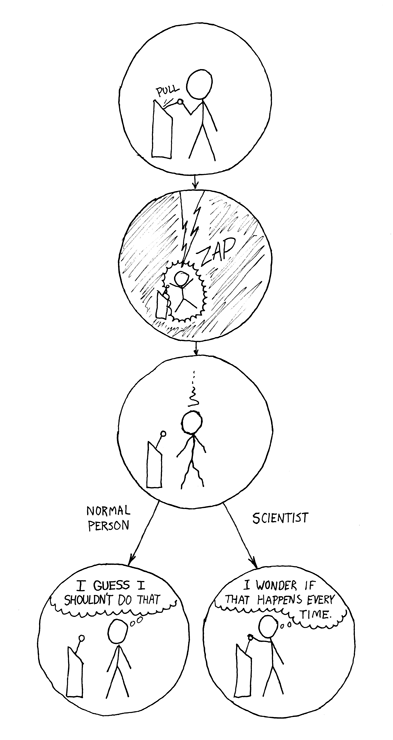
The Difference: Normal Person vs. Scientist
Friday, May 12, 2017
A Cuttlefish Clash: The Strongest, Stripeyist Guy Gets the Girl
I know what you’re thinking: “Why hasn’t she written about cuttlefish mating systems?” I understand, cuttlefish are ridiculously cool and you just need to know more about them. You are in luck as a brand new study has been published online about just that topic!
Cuttlefish are cephalopods, which are all predatory, marine animals that have at least eight arms, a siphon for jet-propulsion, and highly developed nervous and sensory systems (specifically the most sophisticated eye of all invertebrates). Those last characteristics make them highly intelligent, with complex learning behavior, to the point that many consider them to be “conscious.” Unlike other cephalopods, all of their hard parts (if any) are internal. That means all of their outside parts are soft, squishy and covered in color-changing skin. Their ability to change color is absolutely amazing, particularly in cuttlefish (just google ‘Flamboyant Cuttlefish’!). Located in their skin are tons of chromatophores (pigment filled bags) that expand or contract to reveal/hide their color. And it’s crazy-fast too. They can alter their appearance in as little as half a second! They use this color change for camouflage, courtship rituals, or just to show you how they feel about you interrupting them with your dive camera (a little personal experience with a mama octopus thrown in there).
Cuttlefish are in the clade Coloidea that also includes squid and octopuses, and a sister group to the Nautilus. They look like squid but have stouter bodies and a fin fringe that runs around their body that they undulate to move. They have separate sexes and an often elaborate courtship ritual. Should a female find a male worthy, she accepts his spermatophore (sperm packet), which he transfers to her with a specially modified arm (hectocotylus). Then the females will use the contents of this packet to fertilize their eggs and lay them in clusters.
Cuttlefish can be seasonal in their mating habits, with some species gathering in the hundreds to find their special someone. Where animals gather to mate, they also gather to strut their stuff. One of the ways they do this is through shear brawn. Basically, the strongest guy gets the girl. A study currently in press in The American Naturalist describes competition between male cuttlefish. Males compete vigorously for female mates. The researchers took a close look at the Common Cuttlefish (Sepia officinalis), a species “renowned for its visual capabilities, rapid adaptive camouflage, learning, and memory.” All those amazing qualities and yet oddly lacking in its ability to identify individual mates or rivals. Seriously, telling boy from girl is a challenge. This means that they must use a signal-response system to recognize each other. This system employs the use of intense zebra-stripe displays. Respond to a zebra with a zebra and you are male. If you don’t want to fight, darken your whole body (sign of alarm), ink and jet away. But extend your fourth arm, darken the skin around your eyes, and dilate your pupils and you know that shit is about to get real: inking, swiping, grappling, lunging, rolling, and biting. An all-out cuttlefish brawl.
A lot of this information is known from lab studies of cuttlefish, but how do they act in their natural environment. To test this, the researchers went to the Aegean Sea near ÇeÅŸmealtı, Turkey and filmed a bunch of cuttlefish. They brought the footage back to the lab to analyze mate guarding and fighting behaviors, frequencies of a series of agnoistic behaviors in individual males, and aggressive behaviors (e.g., bar room brawl scenario). Since it all starts with the zebra stripes, they also compared the intensity between males. They found a generalized sequence of events that correlated to the amount of aggression. For example, just a dark ring around the eye is low-level aggression, adding a dilated pupil ramps it up to medium-level aggression, intensifying the zebra pattern and arching and tilting the body ramps it up even more. The more medium- to high-level aggressive behaviors the more likely the male was to win. The researchers summarize it this way: “weak zebra banding, fourth arm extension, dark eye ring > dark eye ring with dilated pupil, dark face, strong zebra banding, inking > intense zebra display > swiping, grappling > biting, rolling.” This makes sense if you think about it. Fighting may result in injury and injury is costly, sometimes fatal. So you need to make sure you can win. The series of stages allow each male to assess both themselves and their opponent to see if an actual brawl is worth it.
Now, take what you’ve just learned and apply it to this video. It shows exactly the type of bout the authors describe. You may need to watch it twice, once to read the descriptions of what is going on and another to watch for the subtle differences described above. Can you see the color and eye changes?
Just imagine what we will find out as camera systems get faster. Considering the extremely fast rate at which cuttlefish are able to change their colors, it is very likely that we are missing a lot of the more subtle details in communications between males (and probably with females too). We’ll have to revisit this subject in the future.
Allen, J., Akkaynak, D., Schnell, A., & Hanlon, R. (2017). Dramatic Fighting by Male Cuttlefish for a Female Mate The American Naturalist DOI: 10.1086/692009
Learn more about Cephalopods at the University of California Berkeley’s Museum of Palentology and the Monterey Bay Aquarium
Image from the Monterey Bay Aquarium
Thursday, May 11, 2017
Proteins Do Things for You, Look at 'em Folding
Kids, singing about proteins.....I like it.
Tuesday, May 9, 2017
Wednesday, May 3, 2017
Gimme Your Lunch Money!: Feeding Behaviors in Hummingbirds
![]() |
| Ubatuba, São Paulo, Brazil; 9 October 2014 © Almir Cândido de Almeida |
First, a little background on hummingbirds. They belong to the family Trochilidae and are closely related to swifts. Males are typically more colorful that females, having highly reflective feathers on their chest and heads. Perhaps these birds are best known for their unique flying. They are able to produce power with both the down- and up-beat of their wing flap, getting 75 percent of their lift from their wings’ downstroke and the remaining 25 percent from the upstroke. This allows for both increased agility and sustained hovering ability. They are the only birds that truly hover and fly backwards. They also move those wings really fast: 60 times per second! So it is little wonder that they have among the highest metabolic rate among vertebrate animals.
Hummingbirds are specialized and consume predominately nectar. To collect enough nectar to maintain that high metabolism, they forage many flowers each day. But not all flowers are created equally. Their sugar concentration can vary between 20-25 percent. In order to get the most sugar-bang for their hover-buck, hummingbirds must select and protect the richest food patches in their area. Three behavioral strategies have been observed for foraging:
1) Dominance/territoriality – a bird will defend its flowers
2) Intruder/subordinance – a bird sneaks into other patches until it is kicked out
3) Trapline foraging – repeatedly visiting a set of plants in different patches without being territorial.
Often, a bird will perch near a good food source and let others know that it is theirs. But defending a territory can be up to three times more energetically expensive, so those flowers need to be really good.
The researchers conducted their study in Itacolomi State Park in the city of Ouro Preto, Minas Gerais, southwestern Brazil, in the Atlantic forest remnant. They created four artificial food patches, each patch containing a single sugar-water solution concentration of 5, 15, 25, or 35 percent. They observed the birds (using binoculars) for 3 hour stretches in the early mornings and late afternoon, recording all behaviors during that time. They looked at the time spent in each food patch and the behaviors of the birds (feeding, alert, vocalizing, expelling, fighting, frightening, expel attempt) in each patch. In this way, they could identify the birds’ strategies.
They found that the most-visited feeders were those containing the highest concentration of sugar. Five of the seven species observed fed more on the 25-35 percent sucrose feeders. But there was a difference in the frequency of visitations for different species. The Brazilian ruby (Clytolaema rubricauda, pictured above), Scale-throated hermit (Phaethornis eurynome), and Phaethornis spp. visited the 35 percent feeder more often. And the Brazilian ruby won most of the aggressive encounters with other hummingbirds, both total and in individual patches. This species often stood alert and fought more often, and even “stood impassive” when faced down by the Violet-capped woodnymph (Thalurania glaucopis). I wonder if they looked down their long little beaks at the other birds with a f*ck off attitude? What a badass...hmm, or a bully. The Violet-capped woodnymph visited the 25 percent patch more often, the White-throated hummingbird (Leucochloris albicollis) and Versicoloured emerald (Amazilia versicolor) visited the 15 percent patch more often, and the Glittering-bellied emerald (Chlorostilbon lucidus) was the one that less frequently visited the food patches. Interestingly, the Phaetornithinae applied a hide-and-wait strategy, where they would be chased away by the territorial bird only to hide in the shrubs, remain quiet, and return to the feeder after the dominant bird left the area. Sneaky sneaky. The time spent feeding was found to be correlated with aggressive behaviors and also with body size. Big birds, big appetites, big aggression. The subordinate species chose resources depending on the presence or absence of the dominant species, preferring patches that were not guarded. This may be why they were seen in lower concentration sugar patches more often.
Those itty bitty birds can pack some serious aggression. I guess it isn’t really surprising after seeing all of the chasing that goes on around my feeder. Yackety Sax remains appropriate.
Lanna, L., de Azevedo, C., Claudino, R., Oliveira, R., & Antonini, Y. (2017). Feeding behavior by hummingbirds (Aves: Trochilidae) in artificial food patches in an Atlantic Forest remnant in southeastern Brazil Zoologia, 34, 1-9 DOI: 10.3897/zoologia.34.e13228
If you would like to put out your own hummingbird feeder, I recommend this kind because it is simple, inexpensive and does a great job.
The important part is the big red flowers with yellow centers. Hummingbirds really hone in on those color ques. Do NOT use honey in your feeder! And forget the red dye, if your feeder has red color on it then that is plenty to attract the hummingbirds.
Here is a nice and simple recipe to make your own hummingbird food:
¼ cup granulated sugar
2 cups water
Mix the ingredients in a small saucepan. Bring to a boil. Boil for a few minutes or until all of the sugar is dissolved. Let cool to room temperature. Whatever doesn’t fit in the feeder can be stored in the refrigerator.
Increase the recipe as needed, it's a 1:4 ratio of sugar:water
Change the solution in the feeder every 3 days, sooner if it is really hot outside. Make sure to rinse the feeder each time it is refilled. Scrub away any growths (fungi, etc.) as needed.
Brazilian Ruby picture via The Cornell Lab of Ornithology
Feeder image via World of Hummingbirds
Wednesday, April 26, 2017
Whole New Worlds
What happens when you mix the music of Aladdin with astronomy? Something pretty wonderful:
Subscribe to:
Posts (Atom)