The Big Bang Theory is, hands down, my favorite comedy on air right now. I just love those crazy physicists! I also know all the words to the theme song, or I thought I did. Here's the full version by the Barenaked Ladies. Enjoy and just try not to sing along!

Saturday, November 26, 2011


Curiosity to Mars
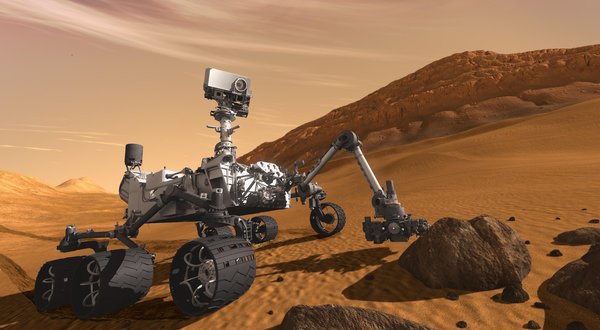
NASA's Mars Science Laborary (MSL) spacecraft launched today aboard the Atlas V rocket. The mission is slated to arrive at the red planet next August 2012. It includes the new Curiosity rover, the world's biggest extraterrestrial explorer. The landing of this large rover will be different than that of Pathfinder, Spirit, and Opportunity which relied on airbags to cushion their landing. The rover will be lowered to the surface using cables suspended from at rocket powered "sky crane" and then use landing rockets to get it gently to the surface. Curiosity is the size of a car (10 feet long and 9 feet wide) and is just too big and heavy to get to the surface using airbags. The rover will spend at least two years exploring the Gale Crater, a site rich in minerals and a likely place to find evidence of past life. Curiosity carries a drill, a stone-zapping laser, 10 scientific instruments, and cameras all designed to see whether Mars may have once been hospitable for microbial life. It should be interesting to see what it finds!
Here's a video of the launch:
And an animation from JPL about the rover's landing and function:
Explore the Mars Science Laboratory Mission Page over at the NASA website.
The New York Times: "NASA Launches Sofisticated Rover on Journey to Mars"
The Telegraph: "Curiosity the Nasa space rover ready for launch for Mars"
Time: "NASA Launches 'Curiosity' Rover to Mars"
UPDATE: August 6, 2012
Curiosity has landed!
Here is the first color image from the Curiosity rover:

 |
| Mt. Sharp, the main science target, with Curiosity's shadow in the foreground. |
Thursday, November 24, 2011
Become a Noun
I've featured videos by Adam Cole (cadamole) a few times on this blog, and expect to see him more as I consider his songs kinda genius. Here's a video he did recently through NPR and Krulwich Wonders.
Adam Cole: When I say "Henry Shrapnel, Jules Leotard, Robert Bunsen," you think — what?
Robert Krulwich: That they're inventors?
Adam: No. Better than that. Each one has become immortal. They're nouns!
Robert Krulwich: Is that a good thing, becoming a noun? ...
Adam: Are you kidding? It's a wonderful thing. A thing to sing about.
Robert Krulwich: You're going to sing?
Adam: If I may ...
Read the rest of the interveiw HERE.
Adam Cole: When I say "Henry Shrapnel, Jules Leotard, Robert Bunsen," you think — what?
Robert Krulwich: That they're inventors?
Adam: No. Better than that. Each one has become immortal. They're nouns!
Robert Krulwich: Is that a good thing, becoming a noun? ...
Adam: Are you kidding? It's a wonderful thing. A thing to sing about.
Robert Krulwich: You're going to sing?
Adam: If I may ...
Read the rest of the interveiw HERE.
Friday, November 18, 2011
Name the Array Contest

Radio astronomy is a subfield of astronomy that studies celestial objects that emit radio waves. This type of astronomy uses large radio antennas or radio telescopes that can be used either singularly or as multiple linked telescopes utilizing radio inferometry and aperture synthesis techniques. It is incredibly useful because radio waves penetrate dust, which can obstruct visible light, and see objects which would otherwise be invisible to us. Astronomers can observe such things as the Microwave Background Radiation (the remnant signal of the birth of the universe in the Big Bang), the generation of galaxies, black holes, and much more.
The National Radio Astronomy Observatory (NRAO) is a facility of the National Science Foundation (NSF). The NRAO was founded in 1956 and provides radio telescope facilities open to all astronomers regardless of institutional or national affiliation. One of the most famous and widely used of their facilities is the Very Large Array (VLA) located on the Plains of San Agustin, about 50 miles west of Socorro, New Mexico, USA. You may recognize it if you have seen the movie Contact. The VLA consists of 27, 230-ton, 25-meter diameter dish antennas that together comprise a single radio telescope system. Over the past few years, the original 1970's vintage electronics that run the telescopes has been replaced with state-of-the-art equipment, expanding the VLA into the Expanded Very Large Array (EVLA) by 2012. This new equipment increases the telescope's technical capabilities by factors of as much as 8,000!
And now this new facility needs a new name!
The NRAO is currently seeking ideas for a new name for the VLA and they want you to submit your ideas. You can enter a free-form name, or a word or phrase to come as a prefix before "Very Large Array," or both. Submissions will be accepted until 23:59 EST on December 1, 2011. The new name will be announced at NRAO's Town Hall at the American Astronomical Society's meeting in Austin, Texas on Tuesday, January 10, 2012.
Visit the Name the Array webpage to learn more and submit your ideas!
(image by Richard Ryer and from panoramio.com, selected for Google Earth ID: 633587)
Wednesday, November 16, 2011

Thursday, November 10, 2011
Monday, November 7, 2011
Scrat in Real Life

Meet Cronopio dentiacutus. A fossil from the La Buitrera locality, Río Negro Province, Argentina was identified as a medium-sized dryolestoid, with an extremely enlongated snout and a pair of curved saber-fangs. Dryolestoids are an extinct mammalian group belonging to the lineage that leads to modern marsupials and placentals. They thrived in South America through the Mesozoic and into the Cenozoic. This specimen was of the early Late Cretaceous (60 million years from previously known), and based on it's dental and cranial features, is unlike previously identified specimens from the Mesozoic.
 |
| Artist depiction of Cronopio dentiacutus |
The paper:
Rougier, Guillermo W., Sabastiam Apesteguia, and Leandro C. Gaetano (2011) Highly specialized mammalian skulls from the Late Cretaceous of South America. Nature: 479, 98-102. (DOI: 10.1038/nature10591)
ScienceShot Article: Meet the Saber-Toothed Squirrel
The Human Biome

Wired recently posted an Atlas of the Human Ecosystem. It is a great infographic that includes some fantastic information. I'm posting their introduction, but follow the link at the end to see the full images.
"If some twisted genius vaporized all 10 trillion cells in your body — along with the hair, the fingernails, and other tissue they create — it would not leave empty space behind. A body-shaped cloud made of bacteria, viruses, and other former stowaways would hover briefly in the air. The cloud would outline your skin, delineate your lungs, trace your digestive tract. You might be gone for good, but your shadow biosphere would remain.
We got our first glimpse of these tiny tenants — now known collectively as the microbiome — in the late 17th century, when a Dutch lens grinder named Anton van Leeuwenhoek noticed a layer of white scum between his teeth. He mixed some of the gunk with pure rainwater and then placed it under one of his handmade microscopes. 'I found, to my great surprise,' he wrote, 'that it contained many small animalcules, the motions of which were very pleasing to behold.'
With the advent of fast DNA sequencing, today’s microbiologists can delve deep into this weird inner universe, and they’re just as amazed as Van Leeuwenhoek was. It’s not just the sheer quantity of microbial cells (100 trillion or so for one person alone) but also their diversity: Each of us is home to thousands of species of microbes, and no two people have quite the same mix.
We’re just beginning to learn the effects our microbiome has on us, but it’s clear that they can be profound. Certain species help digest food and synthesize vitamins; others guide the immune system. Medical researchers have linked obesity, heart disease, and anxiety to properties of the microbiome. In many cases, it’s not the individual species that seem to matter but the richness of the ecosystem. Just as the health of a forest depends upon diversity, our own health appears to benefit from the presence of a wide range of uninvited guests, many of which coevolved with us.
See below for a guided tour of your own personal ecosystem. From the top of your head to the depth of your gut, there’s a jungle in — and on — you."
Visit The Wired Atlas of the Human Ecosystem
Tuesday, November 1, 2011
Subscribe to:
Posts (Atom)
